Creative Change Requests: A Practical Workflow for Teams
Creative Change Requests: A Practical Workflow for Teams

A creative change request is a formal ask to modify a deliverable, design, or project scope after work has already started, distinct from casual feedback because it triggers a review of cost, timeline, and approval. The short answer: require a written request with acceptance criteria, then run it through intake and impact assessment before anyone touches the file. Skip that step and every “quick tweak” becomes a fire drill.
Do this instead:
- Capture every request in a single form, not a Slack message or a hallway comment
- Score impact against scope, schedule, and budget before promising a delivery date
- Route approval to the person who actually owns that level of risk
Teams that skip formal intake tend to discover the real cost of a change only after it’s already blown a deadline. Change requests are inevitable; pretending otherwise is the actual risk, not the requests themselves.
Key Takeaways
A formal intake and impact assessment process turns unpredictable creative change requests into scoped, approvable, trackable work.
| Point | Details |
|---|---|
| Classify before routing | Sort every request into correction, enhancement, pivot, or emergency to match it with the right approval level. |
| Require acceptance criteria | A request without a defined “done” state will bounce back for revision at least once. |
| Assess against the triangle | Test scope, schedule, and budget impact before promising a delivery date. |
| Centralize feedback | Annotated, asset-based comments reduce miscommunication compared with email threads. |
| Use Posthive for provenance | Version history and request tracking give every approved change a documented audit trail. |
Table of Contents
- What Counts as a Creative Change Request?
- Building a Change Request Form That Actually Works
- How Do You Process a Creative Change Request From Start to Finish?
- Estimating Impact Without Guessing
- Templates and Tools That Cut Down on Friction
- Setting Ground Rules So Requests Don’t Pile Up
- Running This Process Inside Posthive
- Where Creative Change Request Processes Break Down
- Measuring Whether Your Change Request Process Is Working
- Getting Stakeholders Aligned Before Changes Turn Into Arguments
- What Successful Change Request Handling Looks Like in Practice
- Sources
What Counts as a Creative Change Request?
A creative change request is any formal ask to alter an approved asset, brief, or deliverable after production has begun. That’s the trigger line: if feedback arrives before a first draft or a locked layout, it’s normal iteration. If it arrives after, it needs a paper trail. The difference matters because unlogged post-approval changes are exactly what blows budgets and turns a two-week project into a six-week one.
Not every request carries the same weight. Sorting requests by type tells you who should approve them and how much scrutiny they deserve.
- Correction — Fixing an error against the original brief: a typo, wrong logo file, misaligned margin. Low risk, usually approved on the spot.
- Enhancement — Improving something that already works: tightening copy, adjusting a color palette, adding a transition. Moderate risk, needs a quick cost check.
- Scope or strategic pivot — Changing direction entirely: a new brand voice, a different campaign concept, a full rebrand shift mid-project. High risk, needs sponsor-level sign-off.
- Emergency or compliance — Legal takedown, accessibility fix, client contractual requirement. Urgent regardless of size, often bypasses the normal queue but never bypasses documentation.
The point of sorting isn’t bureaucracy for its own sake. A correction and a strategic pivot both look like “the client wants a change,” but one takes ten minutes and the other reshuffles three weeks of asset production. Classifying changes by type and routing approvals accordingly is what keeps a design studio from treating every request like a five-alarm fire, or worse, treating a real pivot like a minor tweak.
Building a Change Request Form That Actually Works
A change request form only earns its keep if it forces the requester to think before they type. Loose language like “make it pop more” is not a request, it’s a mood. The form’s job is to convert vague feelings into something a producer can scope.
Here’s what belongs on it:
- Requester name and role — so you know who owns the ask and who to loop in for clarification
- Asset and version number — the exact file being changed, pulled from your version history, not “the latest one”
- Explicit change description — what should look, sound, or read differently, stated as an instruction, not a reaction
- Acceptance criteria — the specific condition that makes the change “done” (e.g., “logo appears at 40px minimum height on all social crops”)
- Business rationale — why this change matters now, tied to a client goal, legal need, or performance data
- Priority and deadline — when it’s actually needed, not when the requester feels anxious about it
- Attachments or references — mockups, competitor examples, brand guideline excerpts
- Estimated impact — optional, but if the requester has a guess on hours or cost, capture it
Acceptance criteria and business rationale do the real filtering. A request without a clear “why” is usually a preference, not a need, and a request without a definition of “done” will bounce back for revision at least twice. Describing the proposed change, its rationale, and its expected benefit up front is what separates a request that gets approved in one pass from one that ping-pongs for a week.
Pro Tip: Make acceptance criteria a required field in your form tool, not an optional one. If a requester can’t articulate what “done” looks like, that’s your signal the request needs a clarifying conversation before it enters your queue, not after.
How Do You Process a Creative Change Request From Start to Finish?
A repeatable six-step workflow turns change requests from ambushes into scheduled work. Skipping steps is how “just one small thing” turns into a rebuild three days before delivery.
- Intake — The requester submits the form. No form, no request. The producer or PM logs it in the tracking system immediately, timestamped.
- Analyze impact — Whoever owns the timeline checks the request against the project management triangle: does it touch scope, schedule, or budget, and by how much? Testing a change against scope, schedule, and budget before promising anything is the single habit that prevents overcommitment.
- Prioritize — Weigh urgency against benefit. A compliance fix jumps the queue. A nice-to-have enhancement waits for the next sprint.
- Approve or route — Route by class: a producer can approve a correction on the spot; an enhancement might need a creative director; a strategic pivot needs the client or sponsor who owns the budget.
- Implement — The team executes, using the locked version as the base so nobody edits over someone else’s in-progress work.
- Close and document — Log the outcome, link it to the original request, and update the timeline and budget tracker so the change is visible to everyone downstream.
Decision points matter as much as the steps themselves. If impact assessment reveals a request will blow the deadline by more than a few days, that’s the moment to pause and re-brief the client rather than quietly absorbing the hit. If a request duplicates one already in the queue, merge them before they turn into two separate rounds of rework.
Rework needs the same rigor as the original request: log it, timestamp it, and adjust the project timeline visibly rather than letting the team absorb it silently. Silent absorption is how a studio ends up profitable on paper and exhausted in practice.
Estimating Impact Without Guessing
Impact assessment is where most creative teams either build credibility or lose it. Vague answers like “sure, we can probably do that” are how scope creep gets its foothold. A concrete answer, even a rough one, protects the timeline and the relationship.
Map every request against the same three dimensions:
- Scope — Does this add a new deliverable, or change the spec of an existing one?
- Schedule — Does it require redoing work already marked complete, or does it slot into unstarted work?
- Budget — Does it need additional hours from a contractor, or extra licensing for a new asset?
Quick heuristics keep this fast instead of theoretical. A copy tweak or color adjustment usually falls under two hours and rarely touches other assets. A layout change that cascades across templates, though, means re-exporting every derivative file and running a fresh QA pass, which can eat a full day even for a “simple” visual update. Anything touching brand voice or campaign concept should be treated as a mini-project with its own timeline, not a line item.
A simple filter cuts through most debates: weigh benefit times urgency against estimated cost. If a request scores high on both benefit and urgency but the cost estimate is small, approve it fast. If the cost estimate rivals the value of the original deliverable, that’s a strategic pivot in disguise and belongs in front of a decision-maker, not a producer. Decision-makers weigh expected impact and alignment to project goals more heavily than raw cost, so framing the request in those terms gets a faster, clearer answer.
Templates and Tools That Cut Down on Friction
Email threads and file names like “final_v3_REALLYFINAL” are where creative change requests go to die. The fix isn’t more discipline, it’s removing the places where miscommunication can hide.
Annotation-on-asset tools beat email because feedback lives exactly where the change needs to happen, pinned to a timestamp on a video or a coordinate on a design file, instead of buried in a paragraph describing where “that thing near the top” is. Centralizing annotated feedback and tracking version history cuts down on the back-and-forth clarification rounds that eat a full day of a producer’s week.
Practical patterns worth adopting:
- Host your change request form as a card template in your project management tool, not a standalone document nobody remembers exists
- Keep one review link per asset version, so stakeholders comment on the current file instead of an outdated export
- Name files by version number and date, never by adjectives like “final” or “approved,” which age badly
- Require every approved change to link back to its original request in your tracker, building an audit trail automatically
Pro Tip: If your team still emails PDFs for markup, that’s costing you more than it looks like on paper. The real cost isn’t the email itself, it’s the twenty minutes a producer spends translating “move it left a bit” into an actual pixel value.
Every change, once approved, should be traceable back to who asked for it and why. Documenting the rationale and approval decision for every request is what protects a team when a client later asks, “Why does this look different from what we agreed on?”
Setting Ground Rules So Requests Don’t Pile Up
Not every stakeholder should be able to submit a change request directly, and not every request deserves the same turnaround. Without ground rules, everyone with a login feels entitled to weigh in on everything, and the queue turns into noise.
Set these rules early, ideally in the kickoff meeting, not after the third round of conflicting feedback:
- Name one or two people per client or department who can submit requests on behalf of their team
- Require feedback in writing, tied to a specific asset or version, never verbal notes passed along secondhand
- Cap the number of reviewers per round to avoid contradictory notes arriving at once
- Set a turnaround SLA for both feedback (how fast reviewers must respond) and approval (how fast a decision-maker signs off)
Coaching stakeholders toward actionable feedback pays off fast. Instead of accepting “this doesn’t feel right,” ask what specifically isn’t landing: the color, the pacing, the message. Codifying who can comment and how feedback should be formatted measurably cuts down on late-stage pivots that blow up an otherwise on-track timeline.
Running This Process Inside Posthive
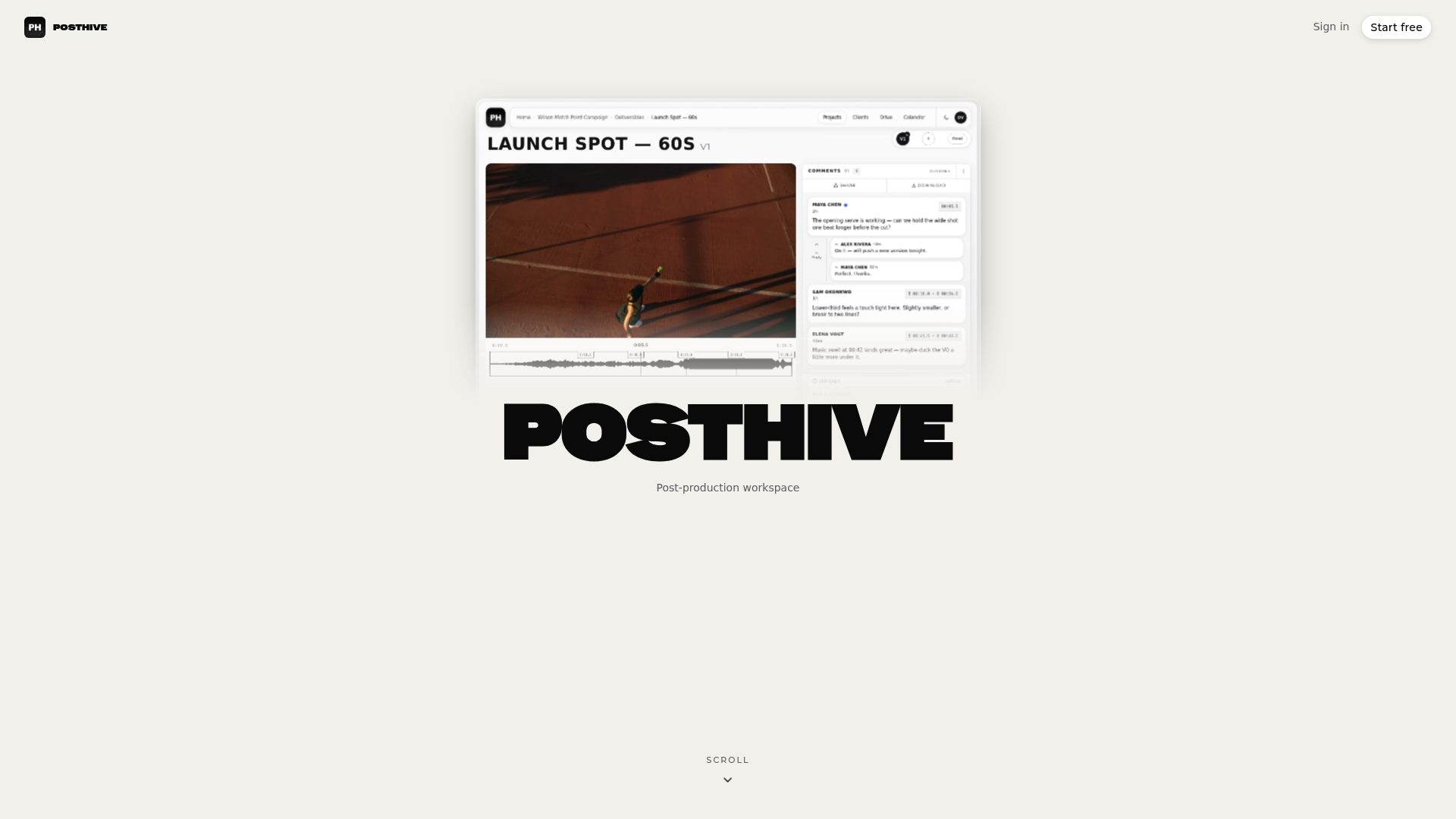
Posthive maps directly onto each step of this workflow instead of forcing you to bolt a form onto a tool that wasn’t built for it. Intake happens through a request form tied to the specific asset and version, so nothing arrives disconnected from its context. Contextual comments sit directly on the file, which replaces the email thread entirely. Version history gives every request a clear “before” to reference, and task tracking gives you a visible record of who approved what and when.
Setting up a workspace for this takes three moves:
- Build your change request fields directly into a task template so every new request captures rationale and acceptance criteria automatically
- Set approval routing by role, so corrections clear fast while strategic pivots route to the right decision-maker
- Migrate active projects one at a time, starting with new requests only, so you’re not retrofitting history mid-deadline
| Step | Posthive Feature |
|---|---|
| Intake | Request form linked to asset and version |
| Review | Contextual comments on the file itself |
| Approval routing | Task assignment tied to role |
| Documentation | Version history and audit trail |
Where Creative Change Request Processes Break Down
Most breakdowns happen at the same three points, and none of them are technical.
The first is verbal approval. A client says “looks great, go ahead” on a call, and nobody writes it down. Two weeks later, when the client sees the final version and doesn’t remember approving a specific detail, the team has no record to point to. Every approval, however small, needs a written trace.
The second is scope creep disguised as a small ask. “Can we also just…” is the most expensive sentence in creative production because it rarely gets logged as a real request. Treat every “just one more thing” as its own line item, even if it takes five minutes to execute.
The third is skipping impact assessment on requests that feel small. A one-word copy change sounds trivial until it turns out that word appears on twelve templates across four languages. Size the request before promising a timeline, not after starting the edit.
A quieter pitfall: treating every stakeholder’s feedback as equally weighted. When five people comment on the same asset with contradictory notes, the team ends up guessing which opinion wins, which usually means redoing the work twice. Fix this by designating one final decision-maker per asset before the review round even opens, not during the argument that follows.
Measuring Whether Your Change Request Process Is Working
A handful of numbers tell you whether your process is actually reducing chaos or just adding paperwork on top of it.
Turnaround time from request submission to approval decision is the clearest signal. If this number creeps up over several months, requests are sitting in someone’s inbox instead of moving through a defined queue.
Rework rate, the percentage of approved deliverables that get revised again within a short window, tells you whether your acceptance criteria are doing their job. A high rework rate usually means “done” wasn’t defined clearly enough at intake.
Request volume by type shows you where your process needs reinforcement. If emergency requests are climbing as a share of total volume, something upstream, like brief quality or client alignment, is failing before requests even reach your queue.
Budget variance tied to approved changes separates change management from cost overrun. Every approved change should carry an estimated cost; comparing that estimate to actual hours spent tells you whether your impact assessment step is calibrated or just guessing.
Approval cycle count, how many rounds a single request takes before final sign-off, flags where communication is breaking down. A request that takes four rounds to approve usually means the original ask wasn’t specific enough, or the reviewer group was too large.
None of these need elaborate dashboards. A shared spreadsheet or a tracking view inside your project tool, updated weekly, is enough to spot a trend before it becomes a pattern that costs a client relationship.
Getting Stakeholders Aligned Before Changes Turn Into Arguments
Alignment problems almost never show up as open conflict. They show up as a client approving a direction in a meeting, then requesting a completely different one three days later, because the meeting conversation and the written brief never matched.
The fix starts before any creative work begins. Confirm the brief in writing and get explicit sign-off on it, not just a verbal nod in a call. When a change request references “the original direction,” everyone should be pointing at the same document.
During review rounds, name a single point of contact on the client or stakeholder side who consolidates feedback before it reaches the creative team. This one habit eliminates the most common alignment failure: five people sending five different notes on the same file, each assuming their note is the priority.
For high-stakes or strategic pivots, hold a short live conversation instead of relying on written comments alone. Tone and intent get lost in a comment thread; a five-minute call often resolves a disagreement that would have taken three rounds of asynchronous back-and-forth to untangle. Follow that call with a written summary so the verbal agreement becomes a documented one.
Finally, revisit alignment at natural checkpoints, not just at kickoff. A project that runs six weeks or longer should have a midpoint check where the team confirms the original brief still reflects what the client actually wants, before a late-stage change request reveals the gap the hard way.
What Successful Change Request Handling Looks Like in Practice
Consider a rebrand project where the client requests a color palette shift in week four of a six-week engagement. Handled ad hoc, this request would mean re-exporting every asset already produced, with no clear estimate of hours or new deadline, and no record of who approved the pivot.
Handled through a formal process, the same request looks different. The client submits it through the intake form, stating the rationale (updated brand guidelines from a parent company merger) and acceptance criteria (new palette applied across all digital touchpoints by a specific date). The team runs impact assessment against the project triangle: scope expands to include a palette audit across twelve existing assets, schedule shifts by four days, and budget needs an additional eighteen hours. Because the rationale is tied to a business requirement, not a preference, the creative director approves it within a day, and the timeline update goes out to the client with the new delivery date attached.

A smaller example plays out just as clearly. A freelance video editor gets a request to shorten a client’s promotional video from ninety seconds to sixty. Instead of guessing which sections to cut, the editor asks for acceptance criteria: which message must survive the cut. That single clarifying question, prompted by a required form field, turns a vague ask into a scoped task completed in one pass instead of three rounds of “try again.”
Both examples share the same throughline: the request had a rationale, a defined outcome, and a documented approval. Nothing about either example depended on the team being unusually skilled at reading client minds. It depended on the form doing its job before the work started.
A PM’s 48-Hour Checklist After a Major Change Request Lands
When a high-impact request arrives, lock the current version first so nobody edits over it. Log the request immediately, even before you fully understand it. Notify affected stakeholders that a change is under review, so nobody is blindsided by a shifted deadline. Then ask clarifying questions directly: “What specific outcome does this need to achieve?” and “What’s the hard deadline, and what happens if we miss it?” Answering those two questions before touching a single file keeps the team from reacting to fear instead of facts.
— Lorenz
Try Posthive’s Change Request Workflow Template
Posthive gives creative teams a working intake and review system out of the box, so you’re not building a form from scratch and hoping your team actually uses it. Contextual comments sit directly on the asset, version history tracks every change back to its source, and request tracking gives you the audit trail this whole process depends on.
Start by importing your existing change request form into a Posthive task template, then run your next incoming request through it before touching a single legacy spreadsheet. If your team is still routing approvals through email, that’s the first workflow worth replacing. Open the Posthive workspace and set up your first project template today.
Sources
- What is the project management triangle? — AIMS Education
- Mastering change request management: Understanding its essentials, tips, and best practices — Teamwork
- Monday
- Design change requests: Taming the chaos for modern creative teams — Revue