Avoid Reprints: Dailies Review Workflow for Production Workspaces
Avoid Reprints: Dailies Review Workflow for Production Workspaces

A working dailies review workflow moves footage from camera to stakeholder screen through seven fixed stages: workflow memo, checksum-verified ingest, sidecar files (AMF, FDL, Top Sheet), one-light color, proxy transcode, technical QC, and review distribution. Productions that run this pipeline well target delivery of review proxies within roughly 12 hours of wrap. Everything else in this guide explains how to make each handoff reliable enough to hit that number.
TL;DR:
- Producing review proxies within 12 hours of wrap depends on strict adherence to a reliable pipeline, clear ownership, and pre-planned policies for missing inputs.
- Ensuring two verified copies with checksum files during ingest and preserving camera-native filenames enable fast, automated metadata tagging and prevent delays.
- Maintaining accurate sync and metadata with consistent timecode, scene, slate, and take information is crucial for automation and data integrity through post-production.
- Applying only a one-light color pass and logging CDL or AMF choices prevent unnecessary grading work early while preserving creative intent.
- Using a role-based, adaptive review platform with watermarking and precise feedback tools accelerates fast, secure stakeholder review and immediate issue resolution.
Table of Contents
- What Is a Dailies Review Workflow?
- What Belongs in the Pre-Production Workflow Memo?
- How Should a DIT Handle On-Set Ingest and Verification?
- How Do You Keep Sync and Metadata Clean Through the Pipeline?
- How Do You Manage Color and Look Metadata Without Overreaching?
- What Proxy Formats and Burn-Ins Does Dailies Review Need?
- How Should Review Platforms Be Structured for Fast Feedback?
- How Do You Handle QC and Missing Inputs Without Stalling Delivery?
- Who Owns Each Step of the Dailies Handoff?
- What Should the Daily Wrap Checklist and Status Email Include?
- How Does a Workspace Like Posthive Support This Workflow?
- What Conventional Dailies Advice Gets Wrong
- Where Posthive Fits Into Your Dailies Operation
- Sources
- FAQ
What Is a Dailies Review Workflow?
Dailies exist to do two jobs at once: catch technical problems while a reshoot is still cheap, and let directors, DPs, and editors react to performance and coverage before the set moves on by consulting examples and videos demonstrating how dailies help evaluate performances and creative direction. Practitioners who run dailies daily point out that this dual purpose is what makes the process cost-effective rather than a bureaucratic tax on the shoot day, since catching errors early keeps reshoots feasible.
The pipeline itself follows a fairly consistent five-stage shape across most productions: ingest and verify media, sync and organize, apply a one-light color pass, transcode to proxies, and distribute to stakeholders. That five-step model shows up in nearly every serious dailies operation, whether it runs on a laptop cart at video village or a fully cloud-based pipeline.
- Ingest and verify: copy original camera files (OCF) with checksum validation.
- Sync and organize: align audio, apply naming conventions, attach metadata.
- Process: apply one-light color using CDLs or AMFs.
- Transcode: generate proxies for review and editorial.
- Distribute: push to review platforms and editorial storage.
Cloud streaming and automation change the economics here. Instead of a dailies operator manually transcoding overnight, a cloud pipeline starts processing the moment clean files land, which shortens the gap between wrap and review. The tradeoff is that automation is unforgiving about incomplete inputs. A missing Top Sheet or a malformed AMF doesn’t just slow one shot down. It can stall an entire batch until someone catches it.
What Belongs in the Pre-Production Workflow Memo?
Every reliable dailies operation starts with a document, not a camera. A workflow memo written before day one is what keeps DITs, colorists, and editors working from the same assumptions instead of discovering conflicts mid-shoot. Netflix’s own dailies guidance treats this memo as foundational, noting that cross-department planning around camera choices, color, and deliverable specs heads off the most common production pitfalls.
The memo should nail down, at minimum:
- Camera bodies, codecs, and resolution per unit.
- Aspect ratio and any protection framing requirements.
- The color pipeline: LUT, CDL, or ACES/AMF workflow.
- Deliverable specs for editorial, VFX, and the studio or client.
- A named owner for each handoff (DIT, dailies operator, colorist, editor).
The memo also needs to declare a policy for missing or broken inputs before it becomes a crisis on set. Most cloud dailies platforms let a production choose between three behaviors when a sidecar file is absent or corrupt: hold the affected shots, deliver everything that’s correct and flag the rest, or deliver all footage unprocessed and reprint later once fixed. Pick one in advance. Arguing about it at 2 a.m. after a card comes in with no Top Sheet is how good crews burn goodwill.
Camera tests and framing charts matter more than most schedules give them credit for. Running a full round trip, camera through dailies through review, before the first shoot day exposes color pipeline mismatches and LUT errors while they’re still free to fix.
Pro Tip: Shoot your framing chart test in the exact aspect ratio and protection format you’ll deliver, not just the camera’s native frame. A test that only validates the sensor crop misses the exact error that shows up three weeks into production.
How Should a DIT Handle On-Set Ingest and Verification?
The DIT’s job on ingest is not “copy the cards.” It’s building an auditable chain of custody that automation downstream can trust without a human double checking every folder. That starts with a hard rule: never fewer than two verified copies of original camera files, generated with checksum validation at the point of transfer.
Checksum tools compare a mathematical fingerprint of the source and destination files, byte for byte, so a silent corruption during transfer gets caught immediately instead of surfacing three weeks later in the color suite. ARRI’s own guidance on data transfer recommends keeping an MHL or ASC MHL checksum manifest alongside the archive precisely so a corrupted file can be traced back to the exact copy pass that broke it. Tools built for this, Silverstack, Hedge, and Pomfort among them, generate and log MHL files automatically as part of the copy job, which removes the temptation to skip verification when the day is running long.
DIT ingest checklist:
- Two verified copies minimum, on separate physical drives or RAID volumes.
- MHL or ASC MHL checksum file generated and stored with each copy.
- Camera-native filenames preserved, never renamed at the card level.
- Folder structure matches the naming convention set in the workflow memo.
- Top Sheet or Editor Log packaged with the OCF before upload, not sent separately.
Statistic Callout: Productions aiming for the industry’s roughly 12-hour proxy delivery target lose most of that buffer to ingest delays, not processing time. A DIT who uploads clean, correctly named files with checksums attached is doing more to protect that deadline than any render farm upgrade.
Camera filenames matter more than they get credit for. When a system can match a camera-native filename to a Top Sheet entry automatically, it can mark circle takes and route selects into editorial bins without a human touching the metadata. Rename files at the card level and you break that automation before it starts.
How Do You Keep Sync and Metadata Clean Through the Pipeline?
Metadata is the plumbing nobody notices until it leaks. Timecode-based sync remains the most reliable method for matching picture and sound, with waveform matching as a solid fallback when timecode jam sync fails or a recorder drifts. Whichever method you use, the goal is the same: get iXML-tagged sound files, an ALE or AAF export, and a Top Sheet that all agree on scene, slate, and take naming.

The Top Sheet, sometimes called an Editor Log, functions as the naming spine for the entire dailies operation. Script supervisor guidance for automated dailies systems is explicit that supplying camera filenames on the Top Sheet is the strongest anchor a system has for tagging circle takes automatically. Without that link, someone in post has to manually cross-reference slates against footage, which is exactly the kind of work automation is supposed to eliminate.
Package metadata for downstream systems as:
- iXML-embedded audio files synced to picture.
- An ALE or AAF export matching editorial’s bin structure.
- A Top Sheet with camera filenames, not just scene/slate/take shorthand.
- A change log noting any slate corrections made after the fact.
Timecode drift is the most common failure mode here, usually from a recorder’s internal clock slipping over a long shooting day. The fix is boring but effective: jam sync all sound devices to a common source each morning and re-jam after any battery change. A researcher writing on metadata-dependent automation put it plainly: automation is only as reliable as the human discipline behind Scene/Slate/Take formatting feeding it. No software fixes a slate that was called wrong on set.
How Do You Manage Color and Look Metadata Without Overreaching?
Dailies color work has one job: preserve creative intent, not finalize it. A one-light pass, a fast, consistent balance applied across a scene, is the right scope for dailies. A full grade belongs in post, once an editor has locked a cut and a colorist has time to work shot by shot. Grading too hard at dailies stage wastes time on footage that may not even make the cut.
The mechanism that carries creative intent forward without a colorist re-doing the work is the Color Decision List (CDL) or the ACES Metadata File (AMF). Both are standard, machine-readable ways to encode primary color decisions, and using them means color and look choices travel reproducibly from the set to editorial and VFX without anyone hand-typing slope, offset, and power values into a new system. In an ACES pipeline specifically, per-shot AMFs get validated against reference stills pulled on set, so a colorist downstream can confirm the applied look matches what the DP actually approved.
The ASC Framing Decision List (FDL) handles a separate but related problem: protecting framing intent across aspect ratio conversions. It’s not automatable in the way a CDL is, since framing choices often need a human eye to confirm they read correctly at the target ratio, but logging FDLs consistently means nobody has to guess where the DP wanted the frame line.
- Log every applied CDL or AMF in the shot’s metadata, not just in a colorist’s private notes.
- Treat FDLs as required inputs for any project delivering multiple aspect ratios.
- Reserve full grading for post, not dailies.
Pro Tip: Store your AMFs and FDLs in the same folder structure as your OCF, keyed to the same filenames. A color decision that lives in a separate system from its footage gets lost the first time someone reorganizes a drive.
What Proxy Formats and Burn-Ins Does Dailies Review Need?
Proxy choice comes down to two competing needs: small enough to stream quickly, clean enough to edit or pull VFX plates from. ProRes Proxy and DNxHD remain the standard middle ground, light enough for fast turnaround, robust enough that editors aren’t fighting compression artifacts during a cut. For remote review specifically, adaptive HLS streaming outperforms raw file transfer by a wide margin. HLS avoids forcing a full-file download before anyone can watch anything, and its adaptive bitrate playback means a reviewer on a hotel Wi-Fi connection isn’t stuck buffering a 4K file meant for a studio screening room.
Burn-in overlays matter more than they look like they should. At minimum, dailies proxies need:
- Timecode, running continuously and matching the OCF.
- Scene, slate, and take, pulled straight from the Top Sheet.
- Camera roll or card ID for traceability back to source.
- Frame line or aspect ratio guide, especially on protection formats.
These overlays are what let an editor or VFX supervisor reference a specific frame in a note without opening a separate lookup tool.
Mezzanine masters enter the picture when original camera files can’t be used directly for conforming or VFX pulls, often because of an unusual codec or a debayer setting that standard NLEs choke on. Generating a mezzanine master essentially replaces the OCF as the project’s working source of truth for that footage, which has real implications for archiving: the mezzanine, not just the original, needs its own checksum trail from that point forward.
Processing timelines depend heavily on render pipeline setup, but the productions that hit tight turnarounds usually parallelize transcoding across multiple nodes rather than processing one card at a time on a single workstation.
How Should Review Platforms Be Structured for Fast Feedback?
Structure review deliveries around who needs to see what, not around a single flat folder of everything shot that day. Role-based permissions matter here: a VFX supervisor doesn’t need access to every actor’s off-camera coverage, and a studio executive reviewing selects doesn’t need raw B-roll cluttering their queue.
Adaptive streaming through HLS remains the better default over sending raw files for the same reason it wins at the proxy stage: reviewers get instant playback and can scrub to a specific moment without downloading gigabytes first. That matters even more at the review stage, where a director might be checking notes from a phone between setups.
Frame-accurate feedback is where a lot of dailies systems fall apart in practice. A note that says “the actor’s expression at the end” is useless three weeks later. A pin dropped at an exact timecode with a written comment is not. Structure review sessions to require:
- Timecode-anchored comments, not free-floating notes.
- A visual pin or marker on the frame being discussed.
- A resolved/unresolved status so notes don’t get lost in a scroll.
Security deserves real attention, not an afterthought. Review links carrying unreleased footage are a liability if they leak, so watermarking, expiring links, and password protection should be standard, not optional add-ons reserved for high-profile projects. Integration with editorial storage matters too: a review platform that can’t hand off approved selects directly into the conform bin just adds a manual re-import step that didn’t need to exist.
How Do You Handle QC and Missing Inputs Without Stalling Delivery?
Technical QC on dailies footage is a spot-check discipline, not a frame-by-frame review. A reviewer should confirm monitor calibration is current, debayer settings match the camera’s actual color space, and audio levels sit in a usable range before anything ships to editorial. Automated QC layered on top of that human check should flag dropped frames, audio sync drift beyond a few frames, and any file that fails checksum verification on the receiving end.
Missing or malformed sidecar files are the single most common reason a dailies delivery slips its window. Cloud-based systems handle this through a project-level policy, decided in advance, not improvised per incident. There are three standard configurations:
- Hold: pause delivery of affected shots until the correct AMF, FDL, or Top Sheet arrives.
- Deliver partial: ship everything with correct sidecar files, flag the rest as pending.
- Deliver all, then reprint: send everything unprocessed or with a fallback look, then reprocess once corrected files arrive.
Which one to pick depends on the production’s tolerance for risk. A tight turnaround show leaning toward a same-day cut usually prefers “deliver partial,” since a director can start reviewing good footage immediately while a fix comes in for the rest. A show with more schedule slack might choose “hold” to avoid confusing an editor with two versions of the same scene.
When a corrected AMF or FDL does arrive, a good system doesn’t require rebuilding the whole project configuration to reprocess it. Corrected sidecar files typically get delivered and reprocessed individually, since project settings usually apply only to new incoming uploads rather than retroactively to material already ingested. A portal that accepts a corrected file and automatically triggers reprocessing for just that shot saves everyone from a manual reconform.
Pro Tip: Set an escalation rule that automatically notifies the post supervisor, not just the dailies operator, when more than a set number of shots hit “hold” status in one day. A pattern of missing Top Sheets usually points to a script supervisor workflow problem, not a one-off mistake.
Who Owns Each Step of the Dailies Handoff?
Automation only works when the humans feeding it know exactly what they’re responsible for. A clean ownership matrix prevents the most common failure in dailies operations: two people each assuming the other handled the Top Sheet.
- DIT: ingest, checksum verification, initial file organization.
- Script supervisor: Top Sheet accuracy, scene/slate/take naming discipline.
- Colorist or dailies operator: one-light application, CDL/AMF logging.
- Post supervisor: sign-off on final selects and look approval before wide distribution.
- Editor: confirms proxies and metadata match editorial’s bin structure.
End-of-day communication should route through a single status update rather than scattered messages across three apps. That report needs to state, plainly: what was shot, what processed cleanly, what’s on hold and why, and a link list for editorial to pull from. Sloppy naming conventions erode faster than any other discipline on a long shoot, so enforcing them daily, not just in the pre-production memo, is worth the friction it causes early on.
What Should the Daily Wrap Checklist and Status Email Include?
A tight end-of-day checklist closes the loop between set and post without requiring a meeting.
- Confirm two verified OCF copies exist with checksum files attached.
- Confirm the Top Sheet accompanied the upload, not sent separately.
- Confirm AMF/FDL presence for every shot requiring a color or framing decision.
- Generate and test proxy links before sending them out.
- List any QC exceptions or shots on hold, with a reason for each.
| Item | Why it matters |
|---|---|
| Verified OCF copies + checksums | Protects against silent corruption |
| Top Sheet with camera filenames | Enables automated select tagging |
| AMF/FDL logged per shot | Preserves color and framing intent |
| Proxy links tested before sending | Avoids dead links in the status email |
| QC exceptions listed explicitly | Keeps editorial from guessing what’s incomplete |
The status email itself should stay short: one line stating what shipped, what’s pending, and the review link. Anything longer buries the information stakeholders actually need before their next meeting.
How Does a Workspace Like Posthive Support This Workflow?
None of the steps above happen in isolation, which is exactly where a coordination layer earns its keep. Version control matters the moment a mezzanine master replaces an OCF or a corrected AMF triggers a reshoot of a color pass. Without a clear system tracking which version is current, editors end up working from stale proxies while a corrected one sits unnoticed in someone’s inbox.
Attaching sidecar metadata, AMFs, FDLs, Top Sheets, directly to a deliverable inside a shared workspace keeps that information traveling with the footage instead of scattered across email threads. Task tracking becomes useful specifically for the missing-input problem covered earlier: a “hold” status on a shot can become an assigned task with an owner and a deadline, rather than a verbal note that gets forgotten by lunch. Calendar integration helps enforce the delivery SLA itself, flagging when a batch is approaching its 12-hour target without anyone manually checking timestamps.
Workspace templates and folder rules go further, enforcing the naming conventions and Top Sheet structure decided in the workflow memo so a new dailies operator doesn’t have to relearn the show’s conventions from scratch on day one. A well-structured post-production workflow template does a lot of that enforcement automatically.
Pro Tip: Build your workflow memo’s naming convention directly into your workspace’s folder templates before principal photography starts. Retrofitting naming rules onto three weeks of already-shot footage costs far more time than setting them up front.
What Conventional Dailies Advice Gets Wrong
Most dailies advice treats the process as a technical afterthought, something a dailies operator handles quietly overnight while the rest of production sleeps. That framing undersells what’s actually happening. Dailies review is a decision system, and every missing Top Sheet or unlabeled AMF is a decision someone deferred until it became a production’s problem instead of one person’s oversight.
The advice that’s usually missing is specificity about failure modes. Everyone tells you to “verify your footage” and “keep good metadata.” Few tell you to decide, in writing, before day one, what happens when a card arrives without a Top Sheet. That single policy decision, hold, partial delivery, or deliver-and-reprint, determines whether a missing file costs you an hour or costs an editor a full day of confused notes on footage that later gets reprocessed anyway.
The reader’s real priority should be sequencing: lock the workflow memo and missing-input policy before the camera tests, not after the first shoot day exposes the gap. A coordination workspace like Posthive helps enforce that discipline operationally, but no software substitutes for a production deciding its own rules in advance. Automation amplifies good process. It also amplifies a sloppy one, just faster.
— Lorenz
Where Posthive Fits Into Your Dailies Operation
Posthive centralizes the parts of this workflow that usually live in scattered emails and drive folders: version control for mezzanine masters and reprocessed shots, task tracking for missing-input issues, and a shared calendar to keep your delivery SLA visible to the whole team instead of just the dailies operator.
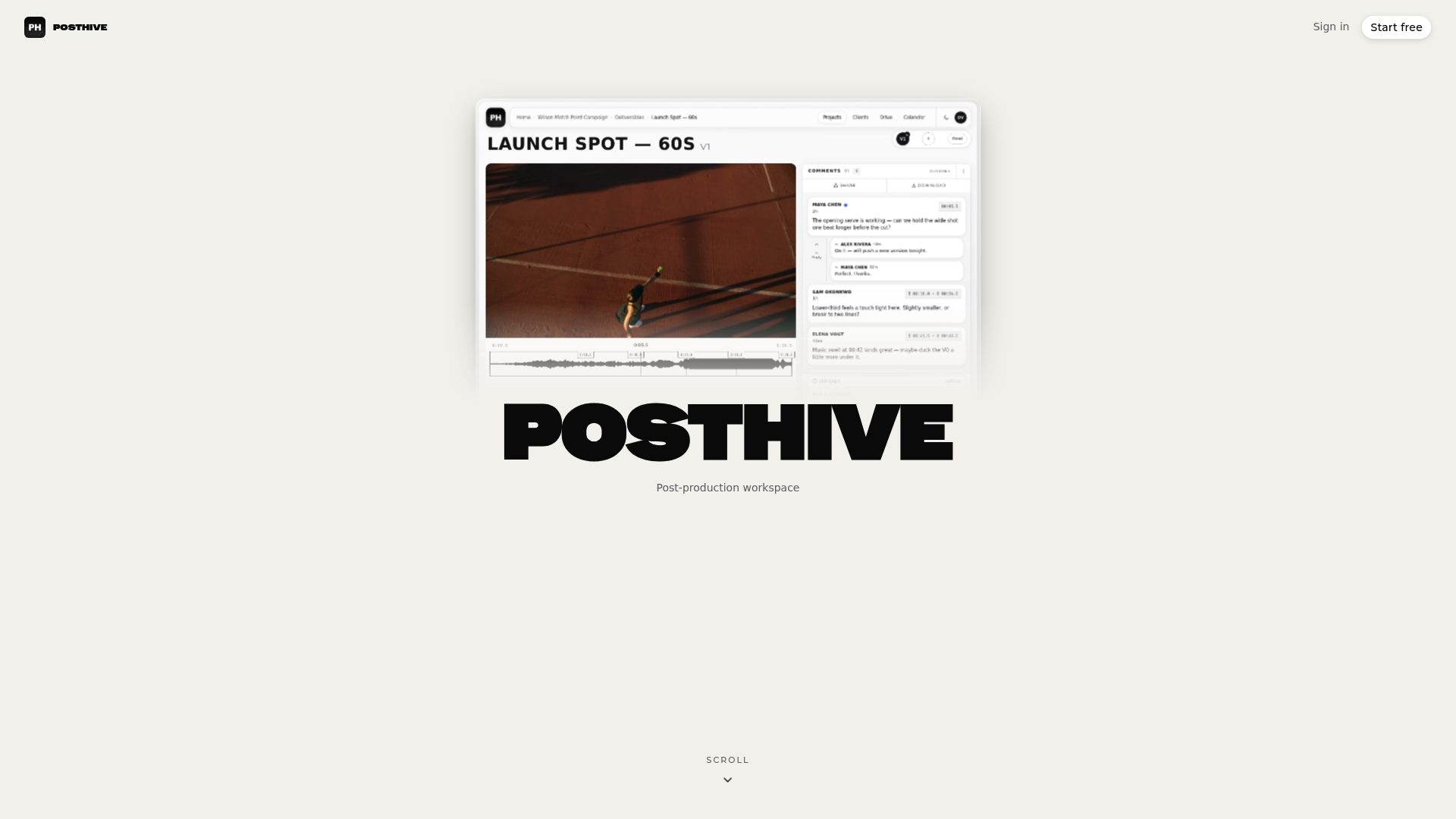
The workspace allows multiple users to review footage and leave frame-accurate notes without extra charges per user login. That matters specifically for dailies, where the reviewer list changes daily and per-seat pricing punishes exactly the collaboration this workflow depends on. The workspace structure page shows how folder templates and naming rules get enforced automatically, which is the same discipline this article argues for in the pre-production memo.
If you’re running dailies across multiple departments right now, start by checking the Pro and Enterprise plans to see which storage and feature tier matches your show’s volume, then set up a project template that mirrors your workflow memo before your next shoot day.
Sources
FAQ
What Is a Dailies Review Workflow?
A dailies review workflow is the end-to-end process that moves raw camera footage from set to stakeholder screens for creative and technical review, usually within a day of shooting. It covers ingest, checksum verification, sidecar metadata (AMF, FDL, Top Sheet), color processing, proxy transcoding, and distribution, with a common target of delivering review proxies within roughly 12 hours of wrap.
What Does “Dailies” Mean in Film Production?
Dailies are the raw, minimally processed footage from a day’s shoot, prepared for review by the director, DP, editor, and other department heads. The term refers both to the footage itself and to the review session or delivery built around it.
Why Are They Called “Dailies”?
They’re called dailies because studios historically screened the previous day’s shot film every single day during production, letting the director and crew catch problems while a scene could still be reshot. The name stuck even as delivery moved from projected film reels to cloud-streamed proxies, since the daily cadence remains the point.
What Is a Content Review Workflow in Post-Production?
A content review workflow is the structured process a team uses to circulate footage, get feedback, and track approvals before final delivery. In dailies specifically, that means frame-accurate comments, resolved/unresolved status tracking, and role-based access, functions a centralized workspace like Posthive can consolidate alongside version control and task tracking.
How Do You Handle Missing Sidecar Files Like AMFs or Top Sheets?
Production should set a policy in advance: hold the affected shots, deliver everything with correct files and flag the rest, or deliver all footage and reprint once corrected files arrive. The right choice depends on schedule tolerance, and most cloud dailies platforms let you configure this behavior at the project level rather than deciding case by case.