Production Teams: Prevent Chain of Title Gaps with Media Sharing Permissions
Production Teams: Prevent Chain of Title Gaps with Media Sharing Permissions

The practical standard for media sharing permissions in 2026 is a role-based, least-privilege model layered with time-limited external shares, mandatory MFA, and complete audit logging. Apply role templates to every project, turn on expiring links for anything leaving your workspace, and enable audit logs before the first client review. Platforms like Posthive build these controls into daily production work, and this guide, from Posthive’s Lorenz, walks through how to set them up correctly.
TL;DR:
- Roles such as editor, client reviewer, VFX vendor, and archivist are mapped to specific permission sets, minimizing access to only what is necessary for each task.
- Using federated identity systems and automated provisioning ensures quick, verified access management, with immediate deprovisioning upon role changes or project completion.
- Expiring links, no-download players, and metadata-aware protections are standard controls to reduce media exposure during external sharing, especially for pre-release content.
- Maintaining detailed logs that record who accessed which asset, when, and from where, supports legal chain-of-title and aids incident response.
- Regular permission reviews at key project milestones prevent drift and over-permissioning, ensuring access aligns with current staff roles and project needs.
Table of Contents
- 1. Core permission types and how they map to production roles
- 2. Identity, provisioning, and lifecycle: getting people in and out safely
- 3. External sharing controls and safe delivery
- 4. Auditability and incident readiness
- 5. Practical workflows across a project’s lifecycle
- 6. Protecting chain-of-title through documentation and permissions
- 7. Common vulnerabilities and risks in media sharing permissions
- 8. Impact of privacy regulations on media sharing permissions
- 9. Technical standards and protocols behind secure sharing
- Why most permission failures aren’t technical.
- How Posthive helps enforce media sharing permissions
- Sources
- FAQ
1. Core permission types and how they map to production roles
Every cloud post-production workspace boils down to five core actions: view, comment or annotate, download, approve, and manage. “Manage” is effectively ownership: it controls who else gets access, what versions exist, and what gets deleted. Assigning these actions correctly, rather than granting broad access by default, is the difference between a controlled review and a leaked cut.
Most productions map cleanly onto a handful of role templates:
- Editor: view, comment, download, and manage within their assigned project folder, never across the whole workspace.
- Client reviewer: view and comment only, with download disabled until a cut is locked.
- VFX vendor: view and comment restricted to specific shots or bins, never the full timeline.
- Archivist: view and download for delivery and preservation, but no comment or approve rights.
Least privilege means each person gets the minimum access needed for their task, nothing more. When a reviewer only needs to leave notes, download access is a liability, not a convenience: every extra download is a copy you can no longer track or revoke. Scoping access by role rather than by convenience is what keeps an accidental forward from becoming a leak.
2. Identity, provisioning, and lifecycle: getting people in and out safely
Manual account creation is where most permission mistakes start. Federated identity through SSO and automated provisioning through SCIM remove the guesswork, tying every account to a verified identity and creating a consistent trail of who was added, when, and by whom. This matters most when freelancers rotate on and off projects weekly, which is standard in production work.
A practical lifecycle looks like this:
- Provision access automatically when someone joins a project, scoped to their role from day one.
- Issue short-lived credentials for external collaborators instead of standing passwords.
- Deprovision immediately when a role changes or a contract ends, not at the next convenient cleanup.
- Recertify access on a set schedule, using logs to confirm who still needs what.
Industry guidance aligned with MPA security practices for media archives recommends exactly this pattern: least-privilege roles, periodic access reviews, and immediate revocation on role changes as core controls rather than optional extras.
Pro Tip: Set recertification reminders at the same cadence as your payroll or contractor renewal cycle, since access changes usually track staffing changes.
3. External sharing controls and safe delivery
Sharing with clients and vendors is where most exposure happens, because it’s the point where media leaves your controlled workspace. The decision is not just “share or don’t,” it’s choosing the right mechanism for the sensitivity of the asset.
- Use expiring, email-verified links for one-off reviews where the recipient doesn’t need a persistent account.
- Add the person as a collaborator with a scoped role when the relationship is ongoing, such as a vendor working across multiple weeks.
- Use no-download players for early cuts, dailies, or anything pre-release, accepting that screenshot protection has limits and won’t stop a determined leak.
- Reserve forensic watermarking or DRM for high-value, pre-release material where a leak carries real financial risk.
Layered, metadata-aware access control paired with time-limited external links and player-based protections is now standard across media-centric asset platforms, not a premium add-on. No download players and expiring links reduce exposure but don’t eliminate it, since a screen recording can still capture what a player blocks from downloading. The right control depends on what happens if the file gets out, not just who’s asking for it.
4. Auditability and incident readiness
If you can’t answer “who accessed this file, and when,” you don’t have a permission system, you have a guess. Minimum viable logging captures five fields for every meaningful action: who, which asset and version, when, from what IP or session, and what action was taken.
- Logs double as delivery receipts: pair them with signed approvals to prove exactly who received which cut.
- Retain logs for the period your distributor or legal contract requires, not just what’s convenient for storage costs.
- When something goes wrong, revoke active links first, rotate credentials second, notify stakeholders third, and preserve the logs before touching anything else.
Centralizing this activity in one workspace instead of scattered tools avoids the inconsistent access policies that create security risk when permissions live in five different places with five different audit trails.
5. Practical workflows across a project’s lifecycle
Permissions shouldn’t be static. What a dailies operator needs in week one looks nothing like what a distributor needs at delivery.
- Ingest and dailies: keep access internal by default, with external review links locked to short expiry windows and no download rights.
- Edit: editors get manage rights within their bin, but cross-project access stays closed unless a supervisor explicitly grants it.
- VFX and vendor handoff: scope access to the specific shots referenced in the edit manifest, not the whole project. Practical vendor handoffs work best when manifests identify exactly which assets are shared and access expires automatically when the shot is delivered back.
- Client approvals: use recorded approval links tied to a specific version, then lock that version once approved so no further edits can slip in unnoticed.
- Delivery: issue signed delivery receipts alongside the final files, confirming exactly which version went to which recipient and when.
Each stage narrows or widens access based on who actually needs it that week, not who needed it last month. Teams that skip this and leave broad access open from ingest through delivery are the ones who can’t answer basic questions when a cut leaks before release.
6. Protecting chain-of-title through documentation and permissions
Permissions aren’t just a security feature, they’re part of your legal paper trail. Rights clearance depends on being able to show who had access to which version and when, tied to the underlying licenses.
- Link your access logs directly to the clearance report and cue sheets, so a distributor’s legal team can trace a version back to its licensing status without a separate investigation.
- Snapshot who received which version at delivery and store the signed approval alongside it, creating a record that matches the file to the person who signed off on it.
- Tie music and clip licensing terms, including synchronization licenses, to the same records so nothing gets separated during a rights review.
Chain-of-title documentation and continuous clearance reporting are not a one-time filing exercise. Clearance has to be updated continuously through production and postproduction, and your permission records are one of the few systems that can prove, after the fact, exactly who saw what and when they saw it.
7. Common vulnerabilities and risks in media sharing permissions
Most permission failures aren’t exotic. They come from a handful of repeated mistakes that accumulate over the life of a project.
Over-permissioning is the biggest one: granting download or manage access because it’s easier than configuring a narrower role, then forgetting to scale it back. Stale accounts are a close second, freelancers who finished a project three months ago but still have an active login because nobody ran deprovisioning. Shared credentials compound both problems, since a single login used by multiple people makes audit logs meaningless, you can no longer tell who actually took an action.
External links without expiry are a quiet risk that tends to surface only after a leak, since a review link sent once can be forwarded indefinitely unless it’s time-limited. Watermark-free pre-release shares carry similar risk: without a forensic mark tying a leaked frame back to a specific recipient, tracing a leak to its source becomes guesswork.
Finally, permission drift, where access accumulates as people move between roles but old grants are never revoked, is what makes a workspace’s permission map stop matching its org chart. A vendor who worked on VFX six months ago may still have view access to the full project if nobody ran a recertification pass. Each of these risks is preventable with the same tools: least-privilege defaults, scheduled reviews, and logging that makes gaps visible before they become incidents.

8. Impact of privacy regulations on media sharing permissions
Privacy regulations shape media sharing permissions any time footage includes identifiable people, whether that’s interview subjects, background talent, or crew captured on set. Regulations like the EU’s GDPR and California’s CCPA treat footage containing identifiable individuals as personal data, which changes who can access it and how long it can be retained.
In practice, this means access to raw footage should be scoped as tightly as access to any other personal data: only people with a production reason to view it should have that permission, and retention periods should be defined rather than indefinite. Consent tracking becomes part of the permission record too, since footage of a person who withdrew consent may need to be pulled from active projects and archives alike.
Cross-border productions add another layer, since a vendor or reviewer accessing footage from a different jurisdiction can trigger data transfer rules that don’t apply to a purely domestic team. None of this is optional paperwork, it directly affects who should hold download rights, how long footage stays in an active workspace, and whether an external link needs additional verification before it’s sent. Specific obligations vary by jurisdiction and by the nature of the footage, so productions handling identifiable subjects should confirm their specific requirements with legal counsel rather than assuming one region’s rules apply everywhere.

9. Technical standards and protocols behind secure sharing
The permission controls described throughout this guide run on a small set of established protocols, and knowing them helps when evaluating whether a platform’s security claims hold up.
OAuth 2.0 is the standard for granting limited access without sharing a password, which is what makes a scoped, revocable external link possible in the first place. SAML handles federated identity for enterprise single sign-on, letting a studio’s identity provider manage who can log in to a vendor’s workspace without creating a separate password to manage and eventually forget to revoke.
Zero-trust architecture guidance recommends short-lived tokens exchanged for locally verifiable JWTs, along with step-up authentication for higher-risk actions like a bulk download or a permission change. This is why a platform asking for re-authentication before a sensitive action isn’t being difficult, it’s applying a standard that assumes any single credential could be compromised.
None of these protocols are visible to a reviewer clicking a link, but they’re what separates a link that can be safely time-limited and revoked from one that, once sent, is out of your control permanently.
Why most permission failures aren’t technical.
The biggest gap I see isn’t a missing feature, it’s teams treating permissions as a one-time setup instead of an ongoing practice. A workspace configured correctly at kickoff drifts within weeks as freelancers rotate on and off, unless someone actively re-checks who still needs access.
Posthive’s version ownership model helps because clients keep control of their own deliverables rather than access living entirely inside a vendor’s system, which makes chain-of-title easier to defend later. My one-line recommendation: review every project’s access list at each major milestone, not just at kickoff.
— Lorenz
How Posthive helps enforce media sharing permissions
Posthive builds these controls into the workspace itself rather than leaving teams to stitch together separate tools for sharing, review, and audit trails. Role templates, expiring shares, and version ownership are part of the same system, so a client reviewing a cut, a VFX vendor scoped to specific shots, and an archivist pulling final deliverables all work from the same permission model without configuration guesswork.
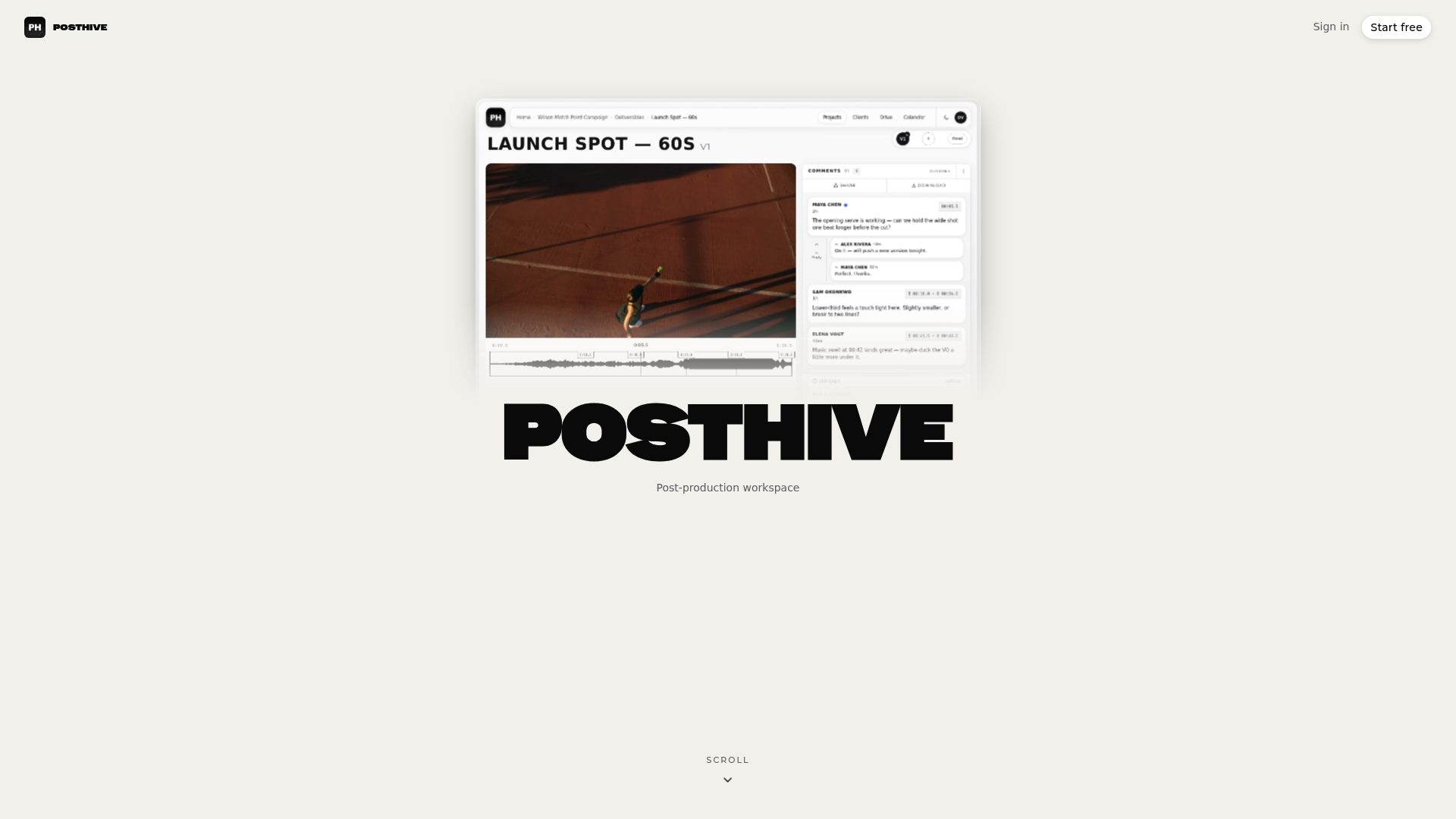
Plans include unlimited seats for teams and clients, so adding a reviewer or a vendor does not incur per-editor charges. Audit logs and version history provide an access trail that clearance reports and delivery receipts depend on. Compare the Pro and Enterprise plans to find the storage and feature tier that fits your production, or visit Posthive to see the workspace in action.
Sources
For teams building out formal policy, WIPO’s rights clearance guide covers chain-of-title documentation in depth, and NIST’s cloud access control guidance details identity lifecycle and provisioning standards. For workflow coordination beyond permissions, Blindspot supports production teams on the content side, and the American Film Association covers distributor expectations around documentation.
- Rights Clearance - A guide for independent filmmakers
- General Access Control Guidance for Cloud Systems (NIST SP 800-210)
- Aligning AWS to MPA security best practices for media archives – Part 1 | AWS for Industries
- Media security and access control | Iconik
FAQ
What is the difference between view and manage permissions?
View permission lets someone see a file or version without editing, downloading, or changing access for others. Manage permission includes full control, including adding collaborators, deleting versions, and changing other people’s permissions, so it should be reserved for project owners.
How often should we review media sharing permissions?
Review access at every major project milestone, such as moving from edit to VFX or from approval to delivery, rather than only at kickoff. Scheduled recertification, informed by access logs and review history, catches stale accounts before they become a risk.
Do expiring links fully prevent leaks?
Expiring links reduce the window of exposure but don’t eliminate risk, since a recipient can still screen record or photograph content before the link expires. Pairing expiring links with no-download players and watermarking narrows the risk further for high-value pre-release material.
Does Posthive support role-based sharing controls?
Posthive includes role templates, version ownership, and audit logging as part of its workspace, letting teams scope access by role for editors, clients, and vendors. Plans are available on the Pro and Enterprise tiers, each with unlimited free seats for clients and collaborators.
How do media sharing permissions support chain-of-title?
Permission records and audit logs create a trail of who accessed and approved each version, which ties directly to clearance reports and cue sheets required for distribution. WIPO’s guidance treats this as a continuous process through postproduction, not a one-time filing step.