Cut Revision Days: Six Steps for Creative Teams' Stakeholder Review
Cut Revision Days: Six Steps for Creative Teams’ Stakeholder Review

A stakeholder review process only works when it guarantees three things: one named approver per deliverable, approval states tied to a specific version, and a single canonical review link everyone uses. Skip any of those and you get the mess most studios live with, endless email threads, conflicting notes, and nobody sure which cut is “the real one.” Posthive is built around enforcing exactly those three rules, and teams that adopt them typically cut revision rounds and get to sign-off faster.
TL;DR:
- Enforcing a single named approver, version-specific approval states, and a universal review link minimizes delays and prevents conflicting feedback.
- Clear version naming, a one-sentence changelog, and exclusive review links help avoid confusion and reduce review cycles.
- Feedback should be timestamped, specific, and categorized into corrections, refinements, or scope changes for actionable review.
- Most projects benefit from limiting review rounds to three, with strict deadlines and escalation procedures to prevent delays.
- Using a unified workspace that tracks versions, feedback, and approvals streamlines the process and cuts down on scattered notes and multiple tools.
Table of Contents
- What Are the Steps in a Stakeholder Review Process?
- Who Should Be Involved in a Stakeholder Review?
- How Do You Prevent Version Confusion During Review?
- How Do You Collect and Organize Stakeholder Feedback?
- How Long Should a Stakeholder Review Take?
- [Which metrics actually predict a broken review process?](#which-metrics-actually-predict-a-broken-review-processhttpsblogautoroiqcomblogad-creative-testing)
- The Posthive Perspective on Structured Review
- Run This Review Process Inside One Workspace
- Sources
- FAQ
What Are the Steps in a Stakeholder Review Process?
A working review pipeline has six checkpoints, and skipping any one of them is where projects lose days. Below is the sequence in order.
- Lock the brief and name the approver. Before a single frame gets cut, write down who has final say. Not “marketing team,” a person. This single decision consistently cuts approval delays more than any tool change.
- Package the version for review. Every cut you send out needs a title, a version number, and a one-sentence changelog describing what changed since the last round.
- Share one canonical link. Send a single review link with access controls and a stated deadline. Multiple links for the same version is how feedback gets scattered across three inboxes.
- Collect feedback in one channel. Timestamped, categorized comments anchored to the asset, not scattered across Slack, email, and a shared drive. Teams that split feedback across tools typically lose four to six days per creative reconciling conflicting notes.
- Consolidate before revising. Someone (usually the producer) merges every note into one clean brief before it reaches the editor.
- Get explicit, written sign-off. The approval has to name the exact version and come from the named approver, then get archived for the record.
Pro Tip: Never let “looks good” in a chat count as approval. Require a sentence that names the version, like “Approved: v5_final for delivery,” so there’s no ambiguity if scope gets disputed later.
Each step exists because skipping it creates rework somewhere downstream. Miss step one and you’ll be chasing five people for sign-off in week three. Miss step three and half your reviewers will be commenting on last week’s cut without realizing it.
Who Should Be Involved in a Stakeholder Review?
Not every reviewer needs the same power. Confusing “gets to comment” with “gets to approve” is the single most common breakdown in creative review, and it’s an easy fix once you separate the roles.
- Craft reviewers (creative directors, editors) judge whether the work is good. They comment, but they don’t hold final sign-off.
- Compliance reviewers (legal, brand, client-side ops) check the work is safe to ship. Their notes are usually binary: fix it or it doesn’t go out.
- Performance reviewers (marketing leads, media buyers) weigh in on whether the asset will actually work for its purpose.
- The named approver is one person, always. This isn’t optional. Ambiguous ownership is exactly what turns a two-day review into a two-week one.
- The consolidator (typically the producer) merges every note before it reaches production, which is what actually prevents extra rounds.
A quick mini-RACI you can paste into any brief: Approver decides. Consolidator merges and resolves conflicts. Craft, compliance, and performance reviewers are all just “Consulted.” Production is “Informed” once sign-off lands.
How Do You Prevent Version Confusion During Review?
Version chaos is the single biggest cause of wasted review cycles, and it’s almost always self-inflicted. Someone reuses a filename, someone reviews an outdated link, and now two stakeholders are arguing about notes that apply to different cuts.
- Never reuse a filename without bumping the version number, even for a five-second fix.
- Keep exactly one canonical link per version, and every version should have one canonical review link tied to it, not three copies floating around different threads.
- Attach a one-sentence changelog to every version. A changelog sentence like “Trimmed intro by 3 seconds, swapped VO in scene 4” saves the producer from re-explaining the change five times.
- Increment the version number for anything a reviewer would notice. Color correction, a new VO take, trimmed pacing, all get a new number. A caption typo fix doesn’t need one.
Good naming: Client_Video_v04_VOswap.mp4. Bad naming: Client_Video_final_final2.mp4.
Pro Tip: If you can’t tell what changed between two versions just from the filename and changelog, your naming system is broken, not your reviewers.
How Do You Collect and Organize Stakeholder Feedback?
Feedback only becomes useful once it’s structured enough to act on. A note that says “this feels off” is useless to an editor; a note with a timestamp, a specific request, and a stated priority is something they can execute in minutes.
Build every feedback form or template around five fields:
| Field | Purpose |
|---|---|
| Timestamp | Points to the exact frame or moment in question |
| Location/scene | Confirms which asset or section the note applies to |
| Request | What the reviewer wants changed, stated as an action |
| Reason | Why the change matters (brand, legal, taste) |
| Priority | Must-fix vs. nice-to-have |
Sort every note into one of three types. Corrections are factual errors, wrong logo, misspelled name, and get fixed automatically. Refinements are taste calls, pacing, color, music, and get weighed against the brief. Scope changes are new asks outside the original brief and need a separate conversation about budget or timeline before anyone touches the edit.
For external reviewers who don’t need a full seat, guest review access keeps their comments attached to the asset and version history instead of arriving as a stray email. The producer then merges every note into one brief, resolving contradictions before production ever sees them. That single consolidation step typically removes a full revision round on its own.
How Long Should a Stakeholder Review Take?
Most standard deliverables should get a 48 to 72 hour review window; large campaign assets with multiple stakeholders can justify five business days, but not more. Cap revisions at two to three rounds, and build the overage rate (extra cost or extra time) into the brief before anyone starts cutting.
- Round 1: broad creative and compliance notes.
- Round 2: targeted fixes only, no new notes.
- Round 3 (if needed): final polish, sign-off expected.
Three messages worth keeping on hand:
- Request: “Round 1 review is ready at [link]. Please respond by [date/time]. Notes should be specific and timestamped.”
- New version notice: “v3 is up, changelog: [one sentence]. This replaces v2 for all review purposes.”
- Escalation: “We haven’t received sign-off from [approver] as of [deadline]. Production is paused until we hear back.”
If the named approver goes dark, escalate to their named backup within 24 hours rather than letting the whole pipeline stall.
Which metrics actually predict a broken review process?
Five numbers tell you almost everything about whether your review process is healthy: time to first view, review cycle time, approval cycle count, resend rate, and late reviewer count. Track these consistently and Cutsio’s operational data suggests they turn vague frustration into a specific, fixable bottleneck.
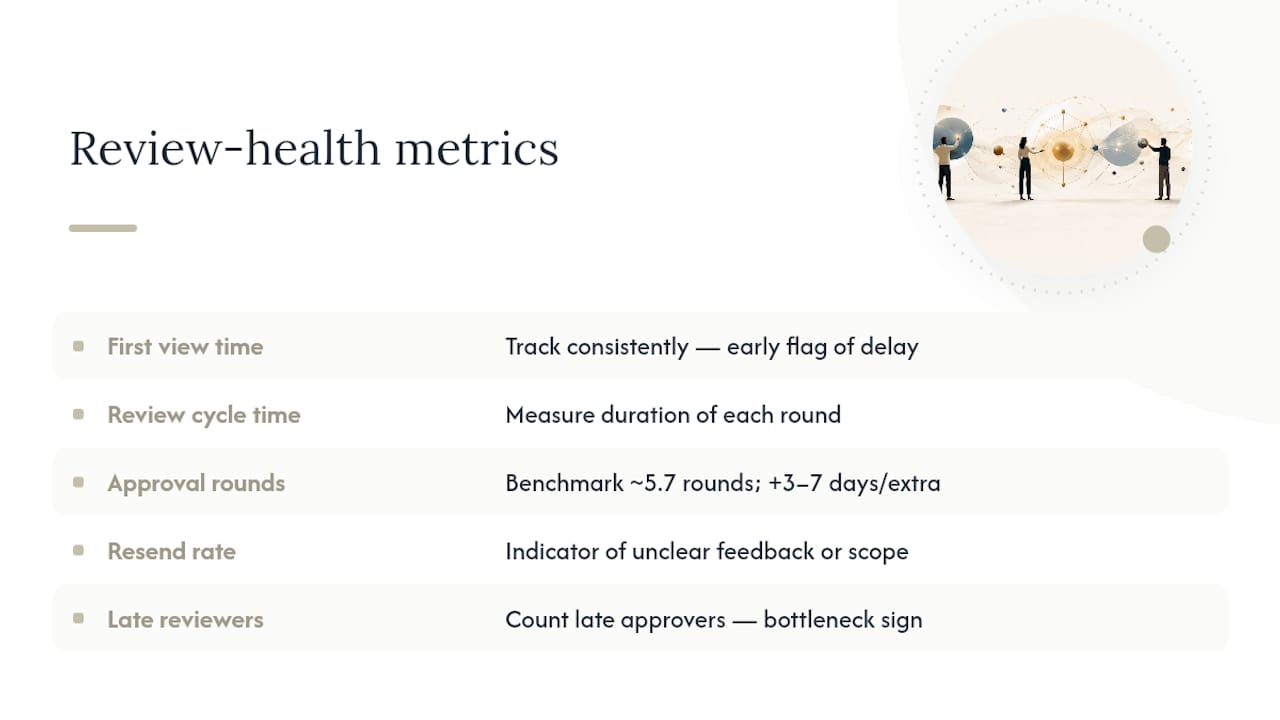
The benchmark that matters most: teams running without a structured process average roughly 5.7 revision rounds per project, with each extra round adding three to seven days. If your cycle count is creeping toward that number, the fix usually isn’t a better editor. It’s a missing named approver.
The Posthive Perspective on Structured Review
Most teams don’t lack discipline, they lack a workspace that enforces it. The platform ties version management, task tracking, and cloud connectivity together so approval states live on the version itself, not in someone’s memory. Guest reviewers can leave timestamped notes, keeping external feedback attached to the right cut instead of drifting into email. The mechanics of a stakeholder review process are well understood; the failure point is almost always tooling that lets people bypass them. Read more on the Posthive blog.
— Lorenz
Run This Review Process Inside One Workspace
The whole review chain, from craft reviewer to client approver, can work inside one canonical link instead of scattered email threads. Version history stays tied to explicit approval states, guest reviewers can comment without a paid seat, and a built-in changelog keeps every cut’s history clear at a glance.
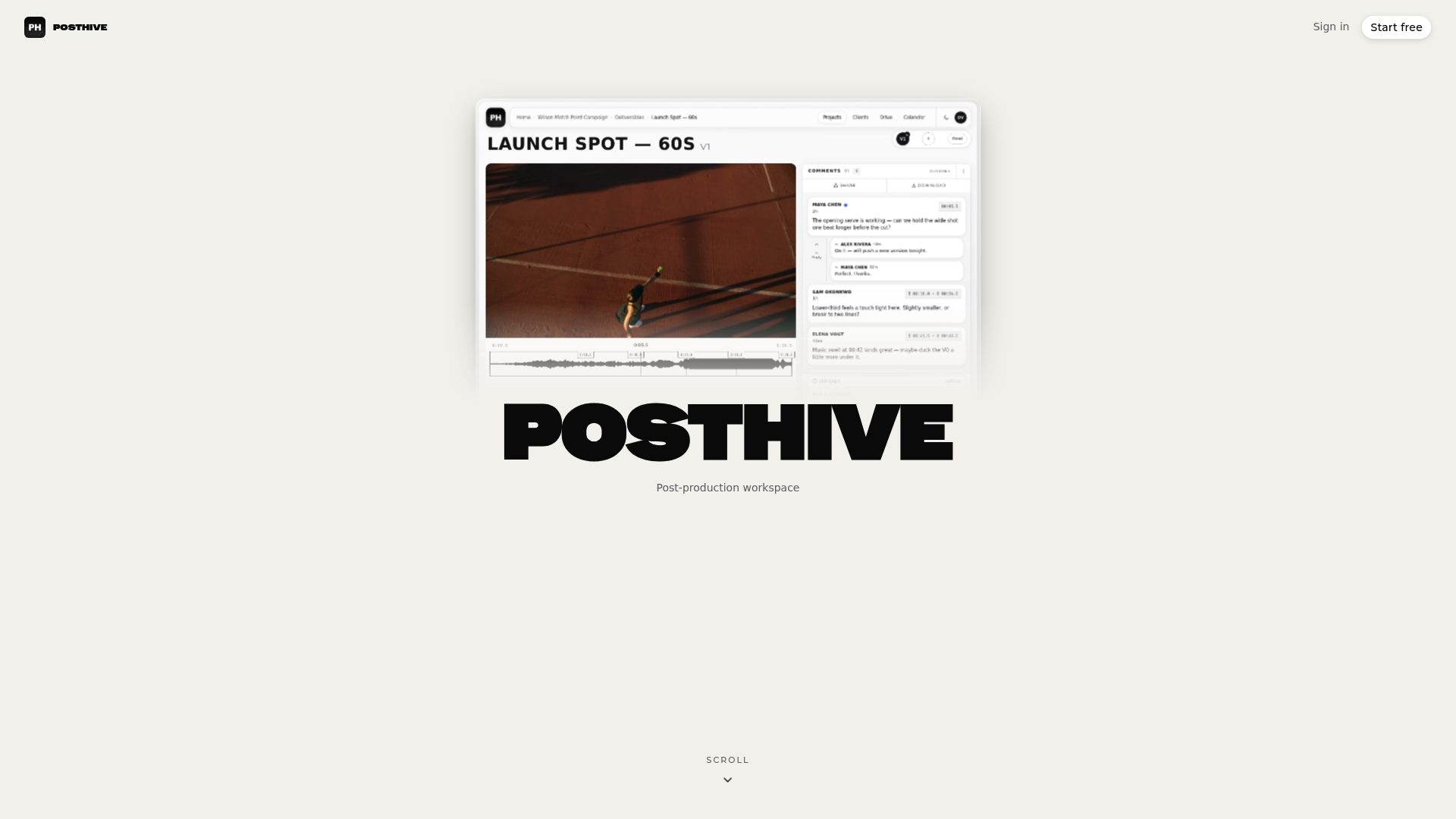
If you’re tired of chasing sign-off across five different tools, it’s worth seeing this in action. Check the Pro and Enterprise plans starting at $49 a month, or start with the free tier to test the approval workflow on your next project. Either way, the fastest way to stop losing days to version confusion is to put the whole review inside a single workspace.
Sources
- How Should a Studio Design a Creative Review and Approval Workflow?
- Video Review and Approval Workflow (2026): A Step-by-Step System for Faster Client Sign-Off
- Video Review and Approval Guide | Global Pictures Sydney
- How to Track Creative Projects, Revisions, and Client Approvals | Deelo Blog
FAQ
What Is a Stakeholder Review Process?
It’s the workflow creative teams use to collect feedback, manage versions, and get formal sign-off on deliverables from everyone with a stake in the outcome. At minimum it needs a named approver, version-tied approval states, and one canonical review link per version.
How Many Revision Rounds Should You Allow?
Two to three rounds is the standard cap for most deliverables, with overage terms defined upfront. Teams without a structured process average about 5.7 rounds, which is where most timelines break down.
What Counts as Formal Approval?
A written, dated statement from the named approver that names the exact version, not a thumbs-up emoji or a verbal “looks great.” That written approval tied to a specific version is the artifact that closes out the project if scope gets disputed later.
Who Should Be the Single Named Approver?
Whoever has final authority to say yes on behalf of the client or internal stakeholders, decided before production starts. It should never be a group or a title, it has to be one person, because ambiguous ownership is the single biggest cause of delayed sign-off.
Can Posthive Handle Guest Reviewers Without Extra Seats?
Yes. Posthive offers unlimited free seats on every plan, so clients and external reviewers can leave version-tied feedback without anyone paying per editor. Pricing for the full workspace starts at $49 a month on the Pro plan.