Four Rules That Fix Video Comment Management for Creative Teams
Four Rules That Fix Video Comment Management for Creative Teams

Centralize every review in one hub, require frame-accurate timecoded comments, name a single approver, and batch feedback into a fixed review window instead of a trickle of ad hoc notes. That combination is the single most effective setup for video comment management, and it works regardless of which software sits underneath it. Four rules to enforce starting with your next review: one hub, one timecode standard, one named decision maker, one deadline.
TL;DR:
- Effective video review workflows require a single hub, clear timecode standards, a designated approver, and a strict review window to reduce revision rounds.
- Enforcing discipline at the start, such as naming approvers and using specific version naming conventions, prevents scope creep and conflicting notes later.
- Using frame-accurate comments linked to a centralized platform shortens review cycles by eliminating ambiguity and reducing the need for multiple rounds.
- Handling late feedback with clear triage rules, locking current versions, and separating internal from client comments avoids schedule delays and scope disputes.
- Tools like Posthive support this disciplined approach by providing integrated version control, timecoded comments, task tracking, and cloud sharing to streamline reviews.
Table of Contents
- Why Frame-Accurate Comments and a Single Hub Change Everything
- What Should Happen Before Every Review Round?
- Two Review Templates You Can Copy Today
- How Do You Handle Conflicting Feedback and Late Notes?
- How Posthive Supports This Playbook
- Making Review Discipline Actually Stick
- Try Posthive for Your Next Review Cycle
- Primary Sources and Further Reading
- Sources
- FAQ
Why Frame-Accurate Comments and a Single Hub Change Everything
Most review chaos traces back to two habits: feedback scattered across email, texts, and sticky notes, and comments too vague to act on. Fixing both is less about buying new software and more about enforcing discipline around the tools you already have.
Projects without a structured review process average about 5.7 revision rounds, and each extra round can tack on several days. That’s not a creative problem. It’s a coordination problem, and coordination problems have process solutions.
Here’s why each rule pulls its weight:
- Frame-accuracy turns feelings into fixable tasks. “The pacing feels off” is useless. “Cut two frames at 00:01:14” is a work order.
- A single review hub kills version ambiguity. When feedback lives in one place, nobody argues over which cut a comment referred to.
- A named approver with a fixed window shrinks calendar drag. Parallel reviews beat sequential ones every time stakeholders wait on each other.
- Consolidation stops conflicting notes from reaching the editor. One producer filtering ten opinions into one set of instructions removes an entire round before it starts.
Frame-accurate, on-asset commenting paired with one centralized hub removes the guesswork that drives most of those extra rounds. The mechanism isn’t magic. It’s just less ambiguity per comment.
What Should Happen Before Every Review Round?
Discipline at kickoff prevents most fires later. Run through this before the first cut ever goes out for review.
- Name the approver and the revision cap in the brief. Decide who has final sign-off and how many rounds are included before it’s a change order, not a negotiation mid-project.
- Pick one review hub and commit to it. Stop accepting comments by text message the moment the official platform goes live. A 48 to 72-hour review window is common and gives reviewers enough time without stalling the schedule.
- Require timecode plus what, where, and why for every comment. A note without a timecode is a comment nobody can act on.
- Adopt one version naming convention and stick to it. “final_v3_reallyfinal” is not a naming system. Archive every version that gets approved so nobody has to hunt for it later.
- Assign a consolidator. A producer or editor should read every note before the editor touches the timeline, resolving contradictions before they reach the cut.
Pro Tip: Confirm who actually watched the cut, and whether they watched the whole thing, before you start consolidating notes. Tracking view completion flags the silent approver who never opened the file, which saves you from chasing a signature that was never coming.
None of this requires fast video production techniques or new software. It requires someone willing to say “comments without timecodes get sent back” and mean it. Structured stages, upload, review, consolidate, revise, approve, are what most effective review workflows have in common, whatever tool sits underneath them.
Two Review Templates You Can Copy Today
Different projects need different review shapes. Here are two that cover most agency and production work.
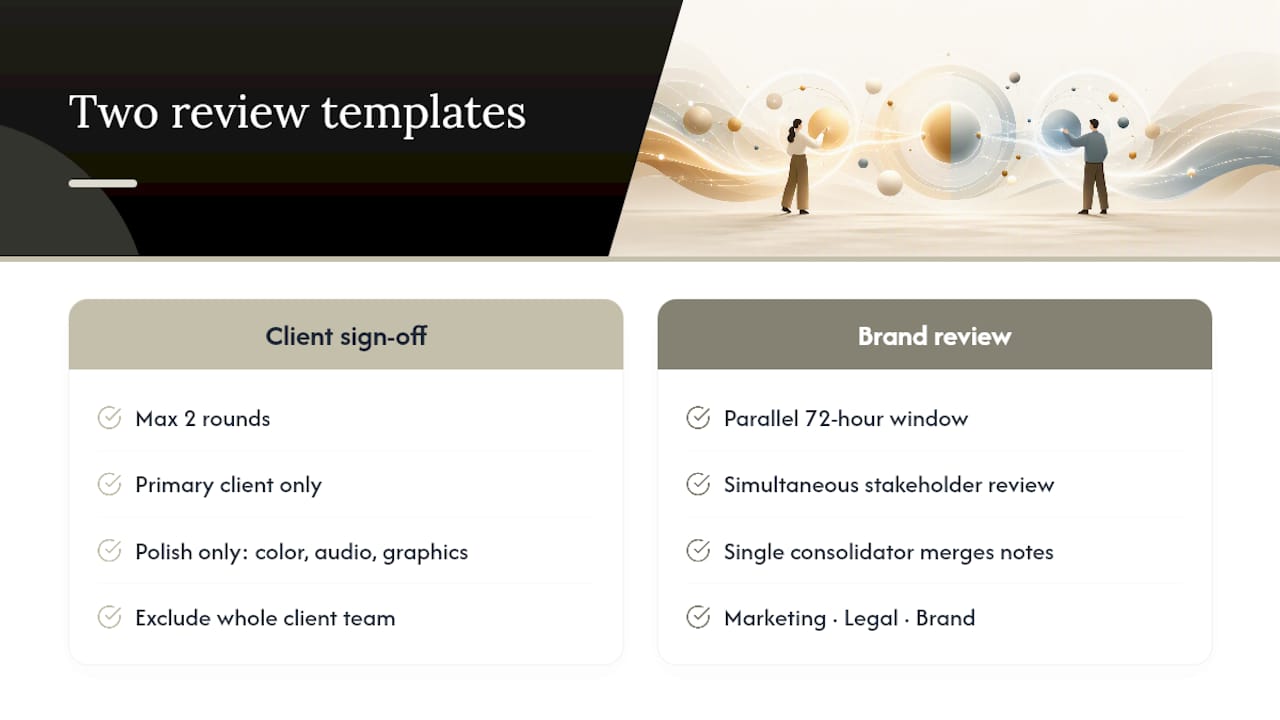
Template A: Fast client sign-off. Cap it at two rounds. Round one includes the client’s primary contact only, not their whole team, reviewing for story and structure. Round two is polish only: color, audio levels, graphics timing. Anything structural raised in round two gets flagged as out of scope and pushed to a follow-up conversation, not absorbed silently into the timeline.
Template B: Multi-stakeholder brand review. Open a parallel 72-hour window so marketing, legal, and brand all watch simultaneously instead of in sequence. A single consolidator merges the three sets of notes into one instruction sheet before the editor sees anything. Build in a legal checkpoint before the final round, not after, so compliance issues surface while there’s still time to fix them cheaply.
For both templates, draw a clear line between structural notes (pacing, sequence, messaging) and cosmetic notes (color, titles, music). Reviewers give sharper feedback when they watch a full sequence in context rather than isolated clips, so lock structural decisions early and only invite cosmetic notes once the cut is close to final. Reopening structure in round three is what turns a two-round project into a five-round one.
How Do You Handle Conflicting Feedback and Late Notes?
Conflicts and late feedback are where most timelines actually die, not in the editing itself. A few rules keep both from derailing a schedule.
- The named approver has final say, and that decision gets written down. Not implied. Written down, timestamped, somewhere everyone can see it.
- Late feedback gets triaged, not automatically absorbed. Decide up front whether it costs a fee, pushes the deadline, or simply doesn’t happen this round. Say so before the deadline passes, not after.
- Make the current version unmistakable. Everyone touching the project should be able to tell which cut is live without asking. Keep an archive of every approved version. Locking approved cuts and keeping them discoverable prevents the kind of scope dispute where someone swears they approved a different edit.
- Split internal and client threads. Keeping internal team notes separate from client-facing feedback stops an in-progress internal debate from accidentally landing in the client’s inbox.
Pro Tip: Fragmented tools and slow file transfers cause more review delays than actual disagreement does. Connecting your transfer, storage, and review infrastructure often turns a review cycle that used to take days into one that takes hours.
How Posthive Supports This Playbook
Every rule above needs a place to live, and that’s the gap Posthive is built to close. It gives production teams one workspace instead of five disconnected tools stitched together with email.
- Version control enforces consistent naming and keeps approved cuts locked and archived, so there’s never a debate about which file is current.
- Timecoded comments attach feedback directly to the frame it concerns, turning vague notes into specific instructions the editor can act on immediately.
- Task tracking assigns and tracks notes to resolution, so a consolidator can see at a glance what’s open, what’s fixed, and what’s still waiting on a decision.
- Cloud delivery keeps clients and internal teams working from the same source of truth without slow transfers eating into the review window.
Teams that adopt this structure tend to see fewer revision rounds, clearer accountability at every stage, and approvals that move faster because nobody’s waiting on a decision that was never assigned to anyone. You can read more setup detail in Posthive’s guide to video version control.
Making Review Discipline Actually Stick
Most teams don’t have a tooling problem. They have a discipline problem, and no software fixes a discipline problem by itself. I’ve watched plenty of production teams buy a new review platform expecting it to solve chaos that was actually caused by nobody enforcing a timecode rule or a deadline.
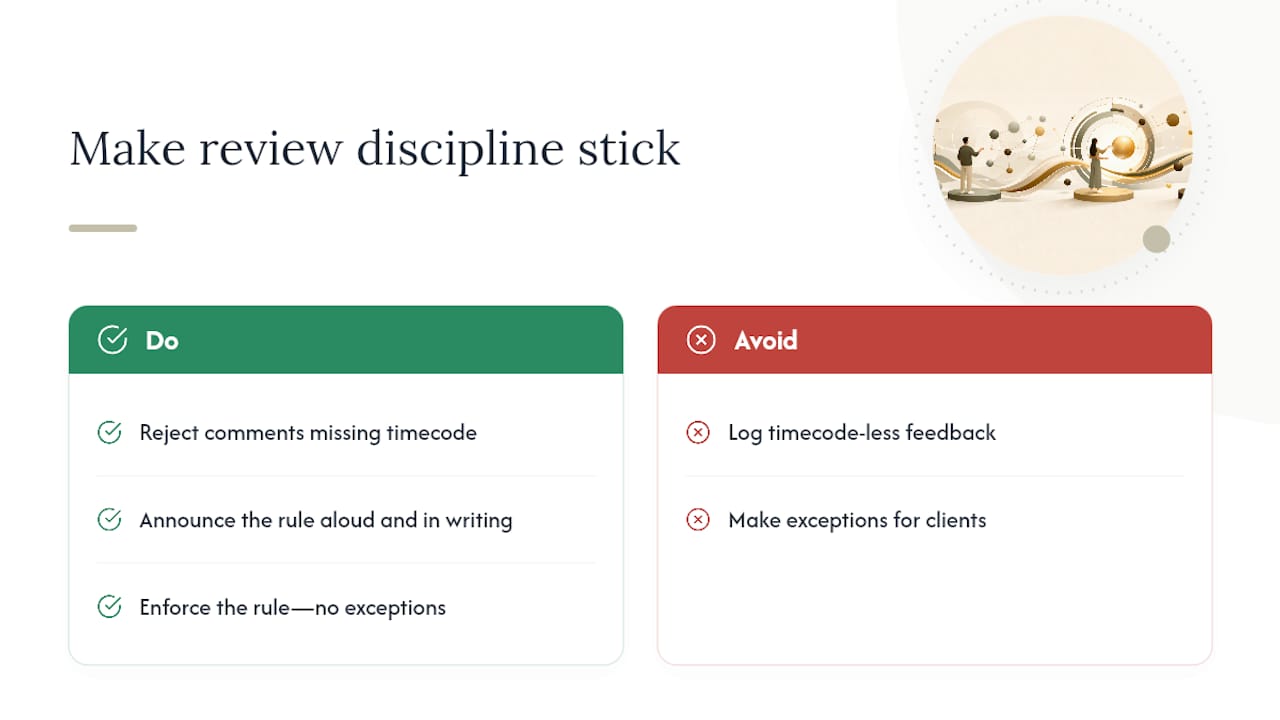
The tool matters less than the willingness to say no to a comment that doesn’t include a timecode. One agency I know of cut a client from four rounds to two just by refusing to log any feedback that didn’t specify a timestamp. Nothing else changed.
Try this on your next review: reject every comment that lacks a timecode, out loud, in writing, no exceptions. See how fast people learn to write better notes.
— Lorenz
Try Posthive for Your Next Review Cycle
If the playbook above sounds right, but your current setup has feedback scattered across three apps and a group chat, Posthive gives creative teams one place to run it instead of five. Every comment lands on the exact frame it refers to, every approved version gets locked and archived automatically, and task tracking keeps a consolidator from losing notes between review rounds.

It supports workflows with named approvers, batched review windows, and a single source of truth for clients and editors. If you’re running reviews across multiple stakeholders or juggling several projects at once, the post-production workflow guide walks through setup in more detail. Start a trial and run your next review through it before your next deadline hits.
Primary Sources and Further Reading
These four sources shaped the recommendations above and are worth reading directly if you want the fuller research behind them.
- Global Pictures Sydney’s review and approval guide documents the 5.7-round average and the cost of undefined approval scope.
- Sohonet’s review bottleneck report covers how infrastructure, not creative disagreement, causes most delays.
- Fastio’s workflow guide lays out the stage-by-stage review structure referenced throughout this playbook.
Sources
- Video Review and Approval Guide | Global Pictures Sydney
- Review Bottlenecks in Post Production: 2026 Fixes | Sohonet
- Video Review and Approval Workflow: A Practical Guide | Fastio
FAQ
What Is Video Comment Management in Post-Production?
It’s the process of collecting, tracking, and resolving reviewer feedback on video drafts, using timecoded comments, a named approver, and version control to move a project from rough cut to final approval without conflicting notes or lost feedback.
How Many Revision Rounds Should a Video Project Have?
Two to three rounds is typical for most projects; without a defined cap, projects without structure average around 5.7 rounds, with each extra round adding several days.
Who Should Have Final Approval on a Video Draft?
One named approver per project, agreed on at kickoff, should hold final sign-off so the team isn’t waiting on multiple stakeholders to agree before an edit moves forward.
Why Do Timecoded Comments Matter So Much?
A comment without a timecode forces the editor to guess which frame or moment a reviewer means, while a timecoded note points directly to the fix, which is one reason frame-accurate commenting shortens review cycles.
Can Posthive Handle Multi-Stakeholder Video Reviews?
Yes. Posthive centralizes timecoded comments, version control, and task tracking in one workspace, which supports parallel reviews from multiple stakeholders while keeping a single source of truth for the current approved cut.