
Agile for Creative Teams: A Practical Guide to Sprints, Reviews and Approvals

Agile works for creative teams when you borrow its rhythm (short cycles, regular reviews, small changes) and leave out its rituals where they get in the way of judgment. The part that decides whether it works is not the sprint board. It is how feedback, versions and approvals move between people. That is where Posthive, our post-production workspace, sits: version control, task and deadline tracking, client review and approval tracking in one place.
TL;DR
- Agile for creatives means short cycles with a review at the end of each one, not a software process pasted onto design or video.
- Frame the problem first, then sprint. Sprints without a clear center produce activity, not direction.
- Plan at less than full capacity, freeze the sprint once it starts, and record new requests as changes.
- Most real production teams run a hybrid of agile and fixed deadlines, and that is fine.
- Review rounds, versions and approvals are where creative sprints stall, so give them one owner and one system.
Table of Contents
- What agile means for a creative team
- Frame first, then sprint
- Does agile limit experimentation?
- Planning and breaking work into iterations
- Feedback, approvals and version control
- Coordinating several projects and deadlines
- Where agile bends: fixed deadlines and hybrids
- Agile for freelancers and solo creators
- Perspective
- Putting it into practice with Posthive
- FAQ
- Sources
What agile means for a creative team
Agile is a way of working in short cycles. You make something small, show it, learn from the reaction and adjust. Scrum, the best-known version, adds named routines: sprint planning, a daily stand-up, a sprint review and a retrospective at the end.
The traditional creative workflow is sequential. Writing finishes, then shooting, then editing, then review. A study of 21 UK agency practitioners found the advertising creative process is made of linked stages: ideas are presented, routes go to the client for approval or revision, and the client consults its own stakeholders before sign-off. Agile does not remove those stages. It shortens the loop between them so a wrong turn costs days, not weeks.
A good example comes from film. In a case described by Scrum Alliance, a team worked on tasks at the same time: while the director and actors shot a scene, the writer worked on the next one and the editor cut the previous one. Everyone then met in a stand-up to review the cut and decide what came next. The filmmakers said seeing the instant impact of their decisions was empowering.

Frame first, then sprint
The strongest objection to agile in creative work is fair. A 2025 essay from a design agency argues that forcing every task into the same sprint rhythm can raise activity while judgment gets thinner. Its remedy is a framing period before the sprint plan: understand the tension, the evidence, the constraints and the decision the work has to help people make.
Take that seriously. A practical version for a team:
- Write a one-paragraph brief that states the decision the work must support.
- Agree what is fixed (brand, runtime, deliverable format) and what is open.
- Only then break the work into sprint-sized pieces.
Riot Games’ Champions team shows how a shared goal replaces a gatekeeper. Its team used a vision statement called “The Dream” as a north star for creative decisions, ran playtests at least once per sprint followed by team feedback, and held a retrospective every sprint. For a video or design team the equivalent is a short vision line plus a review of real work at the end of every cycle.
Does agile limit experimentation?
Not when the cycle includes room to explore. A 2023 paper in the International Journal of Managing Projects in Business identifies five spaces that support creativity inside agile projects: for social interaction, learning, change and adaptation, exploration, and team well-being. Earlier research by Hollis and Maiden found that deliberate idea generation during a sprint, followed by a period of incubation, produced requirements rated as more novel and potentially more useful.
In practice: put one exploratory task in each sprint, give it a time box, and leave the incubation days on the calendar.
Planning and breaking work into iterations
Mike Seymour’s guide to Scrum in VFX is one of the most concrete adaptations for production. Its main points:
- Short planning horizons. Plan in roughly four days of work, so adding one person for a day can normally fix the schedule.
- Plan below full capacity. Assume about 60% efficiency, because meetings, backups, calls and sickness take time.
- Estimate together. Sprint Poker uses Fibonacci-like numbers so the team debates size rather than hours.
- Freeze the sprint. The golden rule is no changes once a sprint starts, which prevents moving targets on commercial projects.
- Small, team-managed tasks tracked on a Kanban board, with daily stand-ups, a sprint review and a retrospective each sprint.
A worked example: a team has a 30-second spot due in three weeks. It runs three one-week sprints. Sprint one ends with a rough cut and a sound pass. Sprint two ends with a graded cut. Sprint three ends with the final deliverable and captions. Each ends with a review, and any new client wish goes onto the next sprint’s list instead of into the one in progress.
Feedback, approvals and version control
This is where creative sprints usually break, and where a workspace matters most. Reviews arrive as email threads, chat messages and marked-up files, then nobody knows which version is current.
A 2026 creative workflow guide offers rules worth adopting: keep one source of truth, tie every version to its master, placement and review status, have one owner consolidate conflicting comments before they go back to production, and log new stakeholders or requirements as changes rather than slipping them into an active revision.
The Creative Scrum team went further and turned its request form into a conversation request where stakeholders describe the problem they want solved, not the solution they imagine.
Here is how we turn those rules into a routine in Posthive:
- Limit rounds. Fix two review rounds per deliverable. Our guides on a two-round creative approval workflow and on enforcing two rounds of revisions show the setup.
- Name one decision-maker. Client feedback and approval tracking in Posthive keeps comments and sign-offs attached to the version they refer to, so the owner consolidates in one place.
- Treat late requests as change requests. Our walkthrough on creative change requests covers how to log and price them.
- Keep versions clean. Posthive’s version management means everyone reviews the same file; see our guide to video version control.
- Track approvals. The approval tracking workflow can be validated in a week.
Clients also keep ownership of their deliverables in Posthive, and unlimited free seats on every plan mean clients and teammates can review without per-editor fees, so the people who need to give feedback can be in the room.
Coordinating several projects and deadlines
Agencies and production companies rarely run one project. The Creative Scrum team used three-week sprints plus a four-month stakeholder cadence, forecasting the next two periods at each meeting to see dependencies and bottlenecks before they became crises. The pattern scales: short cycles for the doing, a longer rhythm for the planning.
To make it work across projects:
- Give every project the same stages and naming so the board reads the same everywhere.
- Put deadlines on a shared calendar. Posthive integrates with Google Calendar and tracks tasks and deadlines; our six-step production deadline playbook walks through it.
- Keep review time in the schedule. Our seven-step creative ops workflow is built around cutting review time.
- Organize media before it multiplies, as covered in how to organize media assets.
For a wider look at managing a team’s output, see our guide to video project management.
Where agile bends: fixed deadlines and hybrids
A 2023 study of VFX teams found that none of the interviewed teams had fully adopted Scrum. Most followed the core agile values and mixed Scrum tools with waterfall, a hybrid the authors named Adapted Creative Agile Management of Projects. Fixed release dates limit endless iteration, and one Scrum Master noted that by the time a retrospective happens, the needed change may already be out of date.
The lesson is to adapt. Keep the short reviews and the freeze on active work. Hold quick retrospectives at natural milestones, such as a locked cut. Accept that your delivery date is fixed and use the cycles to decide what goes into it. For more on coordinating visual work against deadlines, this piece on coordinating visualisation for team projects is a good companion.
Agile for freelancers and solo creators
Solo work needs a lighter version. A guide for solo creators suggests a backlog, a Kanban board with work-in-progress limits (no more than three items in Next and one or two active creation tasks) and a weekly rhythm: pick one outcome on Monday, protect active work midweek, and on Friday mark each item Done, Ready or Stuck. It treats full Scrum as too much for one person, while the sprint goal and review are worth borrowing.

For freelancers the extra step is the client loop. Send versions through one link, keep rounds limited, and record approvals so a disputed change has a paper trail. Posthive has a free plan, so a freelancer can start with that workflow without paying per seat.
Perspective
We built Posthive around a simple belief: creative teams do not need more ceremonies, they need less friction between a cut, a comment and a decision.
Sprints help because they force something to be reviewable every few days. But the review is only as good as the system behind it. When versions live in email and feedback lives in chat, the sprint review becomes an argument about which file is current.
That is why we put project management, version control, client review and secure media delivery in a single workspace, with unlimited free seats on every plan so clients and teammates can all take part. Agile gets easier when everyone looks at the same version and the same list of open decisions.
Lorenz
Putting it into practice with Posthive
If your team is ready to run short cycles with clean reviews, Posthive’s Pro plan is $49 per month and Enterprise is $99 per month, with a free plan to start. Both paid plans are on our pricing page, and you can see how the workspace handles planning on the productivity page.
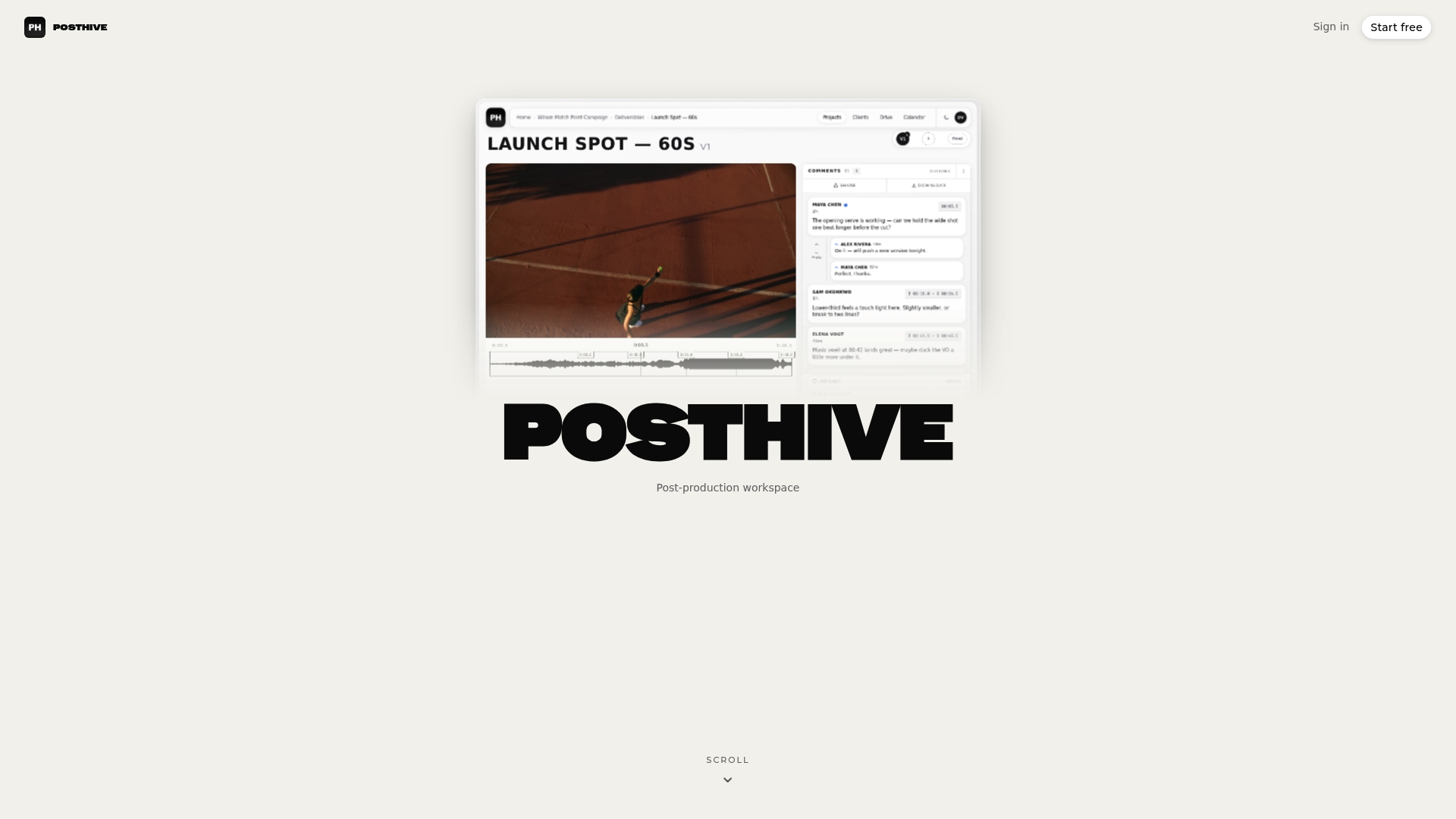
Plugins for NLEs, Google Calendar integration and secure media delivery mean the cycle from edit to review to approval stays in one workspace.
FAQ
Is Scrum right for a creative team?
Often in a lighter form. Research on VFX teams found most use a hybrid of Scrum tools and waterfall rather than full Scrum. Start with short cycles, a review at the end of each and a retrospective, then add more only if it helps.
How long should a creative sprint be?
One to three weeks is common. The VFX guide above describes two to four weeks on larger projects and shorter on a three-week commercial. Choose a length that gives you something reviewable at the end.
How do I handle client changes mid-sprint?
Record them as change requests and plan them into the next sprint. The golden rule in the VFX guide is no changes once a sprint starts. Urgent items can be swapped in only when the team agrees what leaves.
Can a solo creator use agile?
Yes, with a small set of tools: a backlog, a Kanban board with limits on active work and a weekly review. Full Scrum is usually more than one person needs.
Sources
- Agile in Filmmaking, Scrum Alliance
- The Advertising Creative Process, Journal of Marketing Communications
- Creative work needs rhythm, not ritual
- Don’t Go Chasing Waterfall, Riot Games
- Agile project management as a stage for creativity
- Extending Agile Processes, Hollis and Maiden
- Scrum in VFX, fxguide
- Creative Workflow Management
- Creative Scrum
- Managing the Magic behind the Movies, ACAMP
- Agile Business Systems for Solo Creators
- Coordinate visualisation to power team projects