A Practical Captioning Workflow for Production Teams
A Practical Captioning Workflow for Production Teams

A captioning workflow is the sequence of steps that turns raw video into accurate, synced, delivery-ready caption files, from transcription through timecoding, editing, translation, QC, and export. The recommended move for 2026: integrate it right after picture lock, not as a compliance check before delivery. Standards like WCAG and FCC accessibility rules set the floor, but a tool like Posthive turns captions into a managed, versioned asset instead of a last-minute scramble.
Do this next: insert the time-coded transcript into your pipeline as a canonical asset immediately after picture lock, before any style edit or translation begins.
- Treat the transcript as the single source of truth, not a byproduct of the caption file
- Assign a named owner for caption QC before the edit even starts
- Version every caption pass the same way you version a cut
Key Takeaways
A captioning workflow works best when teams treat the time-coded transcript as a canonical asset from picture lock onward, not a compliance step added before delivery.
| Point | Details |
|---|---|
| Integrate captioning early | Insert the transcript right after picture lock to catch placement and sync issues before they become expensive fixes. |
| Standardize the eight-stage pipeline | Move from ingest through delivery with a defined artifact handed off at every stage. |
| Assign clear ownership | Name a producer, captioner, QC reviewer, and localization reviewer with defined handoff artifacts. |
| Version everything | Use immutable revision IDs and semantic versioning so reverting to a verified caption asset is always possible. |
| Use Posthive to centralize the workflow | Posthive maps version control, review, and delivery exports to the exact stages this guide covers. |
Table of Contents
- Why Should Captioning Move Earlier in Production?
- What Are the Core Stages of a Captioning Workflow?
- Who Owns Each Handoff in the Captioning Process?
- Which Tools and Formats Should You Standardize On?
- What Does a Step-by-Step Captioning Workflow Look Like?
- How Do You Manage Caption Versions Without Losing Work?
- How Does Posthive Support a Captioning Workflow?
- The Case for Treating Captions as a Production Asset
- Get Your Captioning Workflow Under Control With Posthive
- Sources
Why Should Captioning Move Earlier in Production?
Fixing a caption problem after delivery costs far more than catching it during the edit. A misaligned name, a garbled brand term, or a caption sitting on top of a lower third that only gets flagged at QC review means someone reopens a locked timeline, re-renders, and resubmits to a platform that already rejected the file once. That is hours, sometimes days, added to a schedule that had no slack to begin with.
The TV Tech analysis on captioning workflows makes the case plainly: captioning should function as content intelligence, not a compliance gate bolted on at the end.
Video analysis that checks frame-level elements, faces, on-screen graphics, and caption placement can prevent distribution rejections and lets caption tracks be treated as verified assets upstream, not an afterthought.
Where the rework actually happens:
- Lower-third graphics colliding with caption placement, caught only after export
- Speaker identification errors in multi-voice interviews or panel content
- Localization teams inheriting a transcript with unresolved brand-name spelling, forcing them to redo work already done once
What Are the Core Stages of a Captioning Workflow?
A captioning process breaks into eight operational stages, and skipping the order costs you later. Each stage should hand off a specific file, not a vague status update.
- Ingest and audio prep, clean audio, isolate dialogue tracks, flag noise or overlapping speech.
- Transcription (ASR pass), generate a raw, time-coded transcript.
- Timecoding and segmentation, break the transcript into readable caption blocks.
- Editorial and style edit, correct names, punctuation, and apply a house style sheet.
- Synchronization and timing, align caption blocks to speech onset within tight tolerance.
- Localization and translation, adapt for each target language and locale.
- QA and visual placement, check for graphic collisions and readability.
- Encoding, delivery, and archival, export final formats and store the master.
Each stage emits a distinct artifact: a raw time-coded transcript, an edited script with a style sheet attached, sidecar files like SRT or VTT, or a burn-in render for platforms that require open captions. The Floniks workflow guide recommends embedding a transcription node directly after video generation so every downstream step reuses the same time-coded source, which helps prevent retiming drift that can occur when transcripts are regenerated at each stage.
QC checks worth running at every stage: sync drift under roughly 200 milliseconds, characters-per-line and characters-per-second within readable limits, caption placement clear of graphics, and non-speech cues (music, laughter, off-screen sound) included for SDH tracks. Floniks notes that automated checks, like re-sampling the audio envelope to catch drift, flag most sync failures before a human ever opens the file.
Who Owns Each Handoff in the Captioning Process?
Ambiguous ownership is what turns a five-step workflow into a two-week back-and-forth. Assign these roles explicitly:
- Producer or coordinator, owns the schedule and final sign-off
- Editor, delivers the locked cut and any name/term lexicon
- Captioner or transcriber, produces the time-coded transcript and edited captions
- QC reviewer, checks sync, placement, and readability against the style sheet
- Localization reviewer, verifies translated captions against source meaning and timing
- Client or approver, signs off on the final deliverable
Each handoff needs a defined artifact, not just a message that says “it’s ready.” Final cut plus lexicon goes to the captioner. Transcript plus style sheet goes to the editor. Attach a revision ID, style sheet version, target locale, and delivery destination to every handoff so nobody has to ask which version they’re reviewing.
Pro Tip: Build a one-page handoff template with those four metadata fields baked in. It takes ten minutes to set up and eliminates the “which version is this?” thread that eats half a production day.
Which Tools and Formats Should You Standardize On?
Your captioning tools matter less than the capabilities they cover. Standardize on:
- Reliable ASR with custom vocabulary support for brand and product names
- Time-coded transcript export that downstream tools can consume without reformatting
- Visual-aware caption placement that flags graphic collisions automatically
- Both sidecar (SRT, VTT, SCC) and burn-in output options
- A translation pipeline that preserves timing across locales
- Version control on every caption pass, not just the video cut
For archival, keep a master transcript plus a per-language VTT or SRT for each locale, and generate burn-in renders only where a platform requires open captions, ad placements often do. Floniks recommends parallel burn-in renderer nodes per platform with named style presets, so one workflow run produces multiple platform-ready cuts instead of manual re-exports for each destination.
Automate the mechanical steps: trigger ASR on ingest, lint SRT files for formatting errors, and run preflight checks before delivery. A tool like Streamline AI fits well for automating those repetitive triggers. Reserve human review for names, legal text, and any high-stakes ad copy where an ASR miss becomes a client-facing embarrassment.
Pro Tip: Never fully automate caption QC on paid media. A single mispronounced brand name in a national spot costs more in reputation than the QC pass would have cost in time.
What Does a Step-by-Step Captioning Workflow Look Like?
Here is a copyable sequence from picture lock to delivery, with realistic time budgets for a five-minute video assuming clear audio and moderate language complexity.
- Ingest and audio prep: isolate dialogue and flag problem audio.
- ASR transcription: automated pass generates the raw transcript.
- Editorial edit: correct names, punctuation, and apply style sheet.
- Timing and sync: adjust caption blocks to speech onset.
- Localization per language: translate and re-time.
- QA pass: check sync, placement, and CPS/CPL limits.
- Encode and deliver: export sidecar and burn-in files.
Longer-form content scales roughly linearly per minute of runtime, but localization overhead grows faster than transcription time once you pass two or three target languages. The Nemovideo caption workflow guide is blunt about this: ASR handles volume, but human post-editing stays non-negotiable for anything client-facing or high-stakes.
| Stage | Deliverable |
|---|---|
| Transcription | Raw time-coded transcript file |
| Editorial edit | Edited script + style sheet reference |
| Localization | Per-language caption file |
| QA | QA report noting sync, CPS/CPL, placement issues |
| Delivery | Sidecar files (SRT/VTT) and burn-in assets where required |
How Do You Manage Caption Versions Without Losing Work?
Version control failures are the silent killer of caption pipelines. A reviewer edits the wrong revision, a hotfix goes out without updating the three localized versions built from it, and now nobody trusts the “final” folder.
Keep the transcript as a single canonical source of truth with an immutable revision ID attached to every change. Use semantic versioning on caption tracks (v1.0, v1.1) so a reviewer can tell at a glance whether they’re looking at a style pass or a full retranslation. Name files consistently: project, locale, revision, no exceptions.
Set review SLAs by pass type: a style edit review should turn around in under 24 hours, a full localization review needs 48 to 72 hours depending on locale count. Plan reviewer capacity at roughly one QC reviewer per three to four active caption tracks in flight.
If a published caption has an error, revert to the last verified revision ID rather than patching forward. Publish the hotfix as a new minor version, then check whether any downstream localizations were built from the broken revision, since those need the same fix propagated, not just the source track.
Pro Tip: Never overwrite a caption file in place. Save every revision with its own ID, even the ones you think are throwaway drafts, because the “throwaway” version is the one someone always needs back.
How Does Posthive Support a Captioning Workflow?
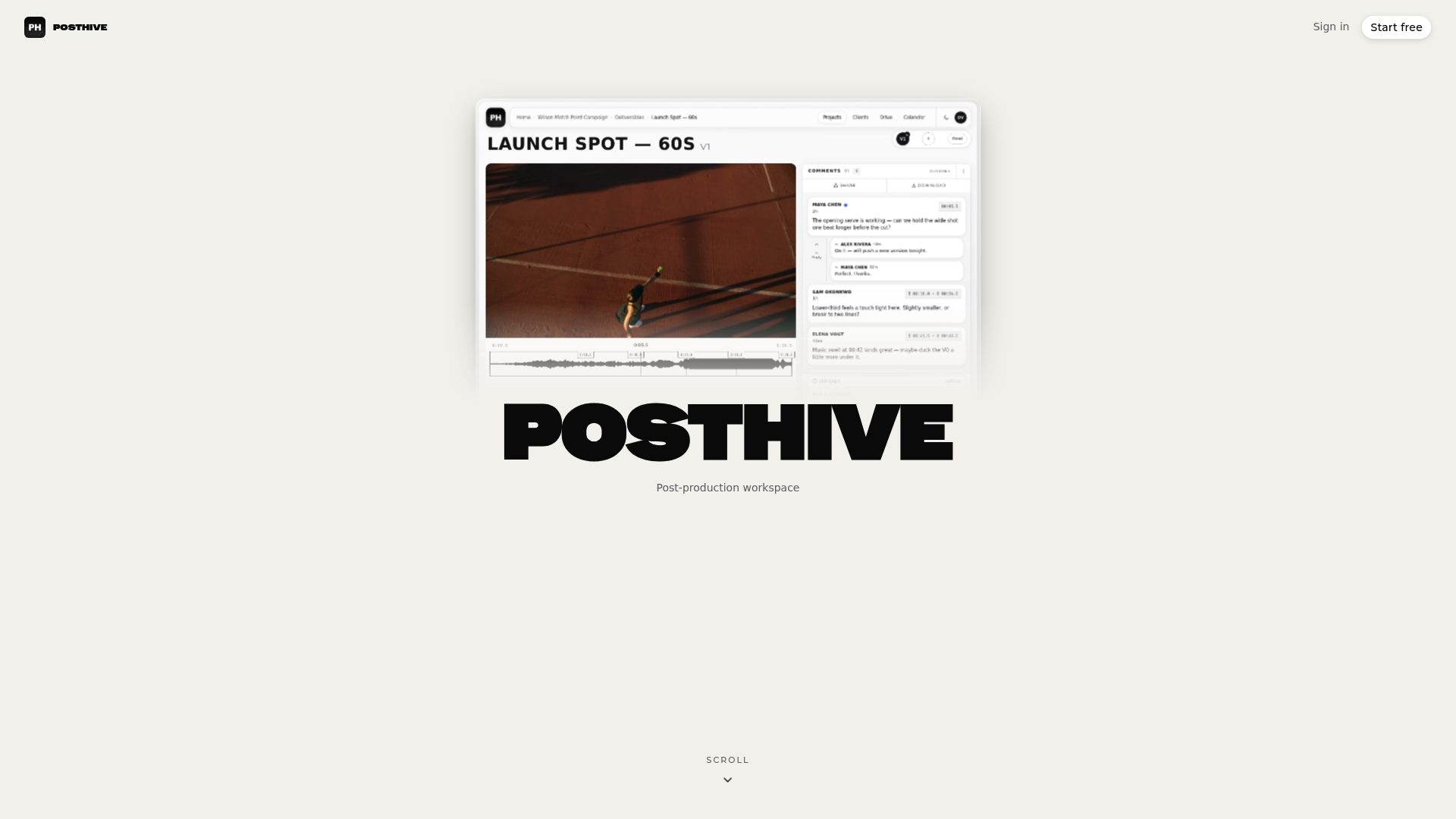
Posthive is a cloud-based post-production workspace, and its core capabilities map directly onto the stages described above. Version control keeps every caption revision traceable instead of buried in a shared drive. Collaborative review tools let a client mark up captions inline instead of emailing timestamped notes back and forth. Task tracking with deadlines keeps localization and QC handoffs from silently slipping.
Concrete places this shortens a cycle:
- Store the time-coded transcript as a source asset that editors, translators, and QC reviewers all pull from the same version
- Run the inline caption editor during client review instead of exporting a new file for every round of feedback
- Track task SLAs per stage so a stalled localization pass gets flagged before it threatens the delivery date
Pro Tip: Run a pilot on a single project with two locales before rolling this out across your whole slate. You’ll see where your current handoffs leak time within a week. Check the Posthive workspace to see how the pieces fit together.
The Case for Treating Captions as a Production Asset
Moving captioning upstream changes the handoff math: editors stop treating captions as someone else’s problem, and QC catches placement conflicts while the timeline is still open. That single shift removes most of the rework this guide describes.
Run the pilot on your next VOD batch, two locales, full pipeline, and measure the QC report against your last project.
The payoff is simple: better accessibility and a delivery date you can actually trust.
Get Your Captioning Workflow Under Control With Posthive
Posthive gives production teams a single place to run the stages this guide just walked through, without juggling five disconnected tools for transcription, review, and delivery. Version control keeps every caption revision traceable back to its source cut. Collaborative review means a client marks up captions directly instead of sending timestamped notes over email. Export tools handle sidecar and delivery formats without a separate app.
Start with one project. Load your next cut into Posthive, route the transcript through review, and see how many email threads it replaces before you commit to rolling it out across your full slate. Try Posthive and run your next captioning pass through it.
Sources
- Why Captioning Workflows Need to Move From Compliance Checks to Content Intelligence | TV Tech
- Adding Captions and Subtitles in a Video Workflow | Floniks
- Best Video Caption Workflow: AI, Accessibility, & Quality Guide