Checklist First Deliverable Sign Off for Project and Creative Leads
Checklist First Deliverable Sign Off for Project and Creative Leads

A deliverable sign-off process is a short, documented workflow for verifying deliverable completeness, obtaining formal acceptance from the authorized stakeholder, and recording that acceptance so the deliverable can be closed. It draws on PMI’s closing process group guidance and relies on a written acceptance form. We see creative teams use this exact pattern to close projects cleanly, and this guide, from Lorenz, lays out the steps.
TL;DR:
- The sign-off process should be a repeatable workflow that verifies version, criteria, and stakeholder feedback before formal approval.
- Sign-off authority must be clearly assigned to a role with documented delegation and an escalation path to avoid delays.
- Acceptance criteria must include specific outputs, measurable pass/fail metrics, and test procedures directly tied to deliverable requirements.
- After approval, closeout tasks such as contract closure, training, and lesson documentation must be completed and records archived properly.
- Media deliverables require strict version control and detailed checklists to prevent confusion and ensure all assets meet technical specifications.
Table of Contents
- The step-by-step sign-off workflow
- How to write testable acceptance criteria
- Who has the authority to sign off
- Building a deliverable acceptance form
- Closeout checklist after sign-off
- How creative teams speed up media sign-off
- Sign-off as a form of stewardship
- How Posthive supports the sign-off workflow
- FAQ
- Sources
The step-by-step sign-off workflow
Sign-off works best as a repeatable sequence rather than a one-time event tacked onto the end of a project. Each step produces evidence, so no one has to rely on a verbal “looks good to me.”
- Receive and verify. Confirm you have the correct version, file set, and metadata before review starts.
- Validate against criteria. Run the agreed QA or functional checks and compare results to the acceptance criteria.
- Collect stakeholder reviews. Gather feedback, resolve open issues, and confirm the deliverable is genuinely ready.
- Obtain formal approval. Secure a signature or digital approval from the authorized signer named in the project’s deliverable management plan.
- Record and trigger closeout. Log the acceptance, update project status, and kick off handover tasks.
Before moving to approval, confirm:
- The deliverable matches the current approved version, not an earlier draft.
- All flagged issues from review have been closed or formally waived.
- The acceptance form is filled out and ready for signature.
Pro Tip: Never let a deliverable sit in “pending review” past a set number of business days; a stalled review is often a silent rejection.
How to write testable acceptance criteria
Acceptance criteria only work when they are specific enough that two different reviewers would reach the same pass or fail decision. Vague language like “looks professional” invites disputes later.
Each set of criteria should include:
- Expected outputs: the exact files, formats, and specifications the deliverable must meet.
- Pass or fail metrics: measurable thresholds, not subjective impressions.
- File formats and versions: the version number and format the acceptance applies to.
- Test cases or QA checks: the specific checks that must pass before sign-off.
- Acceptance owner: the named person responsible for the final call.
A software deliverable might require passing a defined test suite. A documentation deliverable might require a completed review checklist against a style guide. A media deliverable might require a specific codec, resolution, and caption file alongside the master. Attach these criteria directly to the deliverable expectations document or contract so they travel with the deliverable rather than living in someone’s inbox.
Who has the authority to sign off
Sign-off authority should sit with one named role, not a group vote. According to PMI’s deliverable management guidance, the plan should identify exactly who must sign and which tools track status.
Typical ownership looks like this:
- Project sponsor or client: holds final acceptance authority on most contracted deliverables.
- Product owner: signs off on feature or product deliverables in agile environments.
- Operations owner: approves deliverables that transition into ongoing support.
- QA lead and technical reviewer: provide input and validation but rarely hold final authority.
When authority is delegated, document who delegated it, to whom, and for which deliverables. Set a simple escalation path in advance: a disputed deliverable should have a named second reviewer and a deadline for resolution, so disagreements do not stall the whole project.
Building a deliverable acceptance form
A workable acceptance form does not need to be elaborate. It needs the right fields and a predictable location so no one has to search for it later.
Minimum required fields:
- Deliverable name and ID
- Version number
- Acceptance checklist tied to the documented criteria
- Reviewer name and title
- Signature and date
- Notes or conditions attached to the approval
Common template practice for deliverable management plans calls for named approvers, signature and date fields, and an itemized checklist tied to acceptance criteria, which keeps the record audit-ready. A digital workflow might route approval inside a workspace and generate a PDF record automatically; a simpler pattern is an email approval with the signed form attached. Either way, watch for three common traps: missing version numbers, acceptance criteria that were never written down, and no retention policy for the signed record.
Closeout checklist after sign-off
Sign-off is not the finish line. PMI’s closing process group guidance treats formal acceptance as one step inside a larger administrative and operational closure that protects the project’s return on investment.
- Close out contracts, issue final invoices, and release any warranties or performance bonds.
- Draft or finalize the service level agreement for ongoing support.
- Hand over the operations guide, system credentials, and maintenance contacts.
- Deliver training to the team taking over day-to-day ownership.
- Document lessons learned and archive the signed acceptance record.
- Schedule a follow-up check to confirm the handover held up in practice.
Skipping the archive step is a common mistake: a signed acceptance form with nowhere to live defeats the point of having one.
How creative teams speed up media sign-off
Media deliverables carry their own failure points. “Latest version” confusion is a common issue in media workflows, where an editor approves one cut while a client reviews another.
- Keep one authoritative version per deliverable, with prior cuts clearly archived, not deleted.
- Build a checklist that covers the master file, proxies, codec specs, captions or transcripts, and asset metadata.
- Attach review comments directly to the timestamp or frame they reference, not a separate email thread.
Our guide to deliverable version tracking covers this in more depth for media-specific workflows.
Sign-off as a form of stewardship

Treat sign-off as ongoing stewardship, not paperwork at the finish line. A project that defers every acceptance decision to the final week invites scope creep nobody notices until it is expensive.
Keep sign-off visible on every status report and meeting agenda. PMI’s milestone guidance favors short, frequent checkpoints, sometimes called “inch pebbles,” over one large final review, because small checkpoints catch problems while they are still cheap to fix.
— Lorenz
How Posthive supports the sign-off workflow
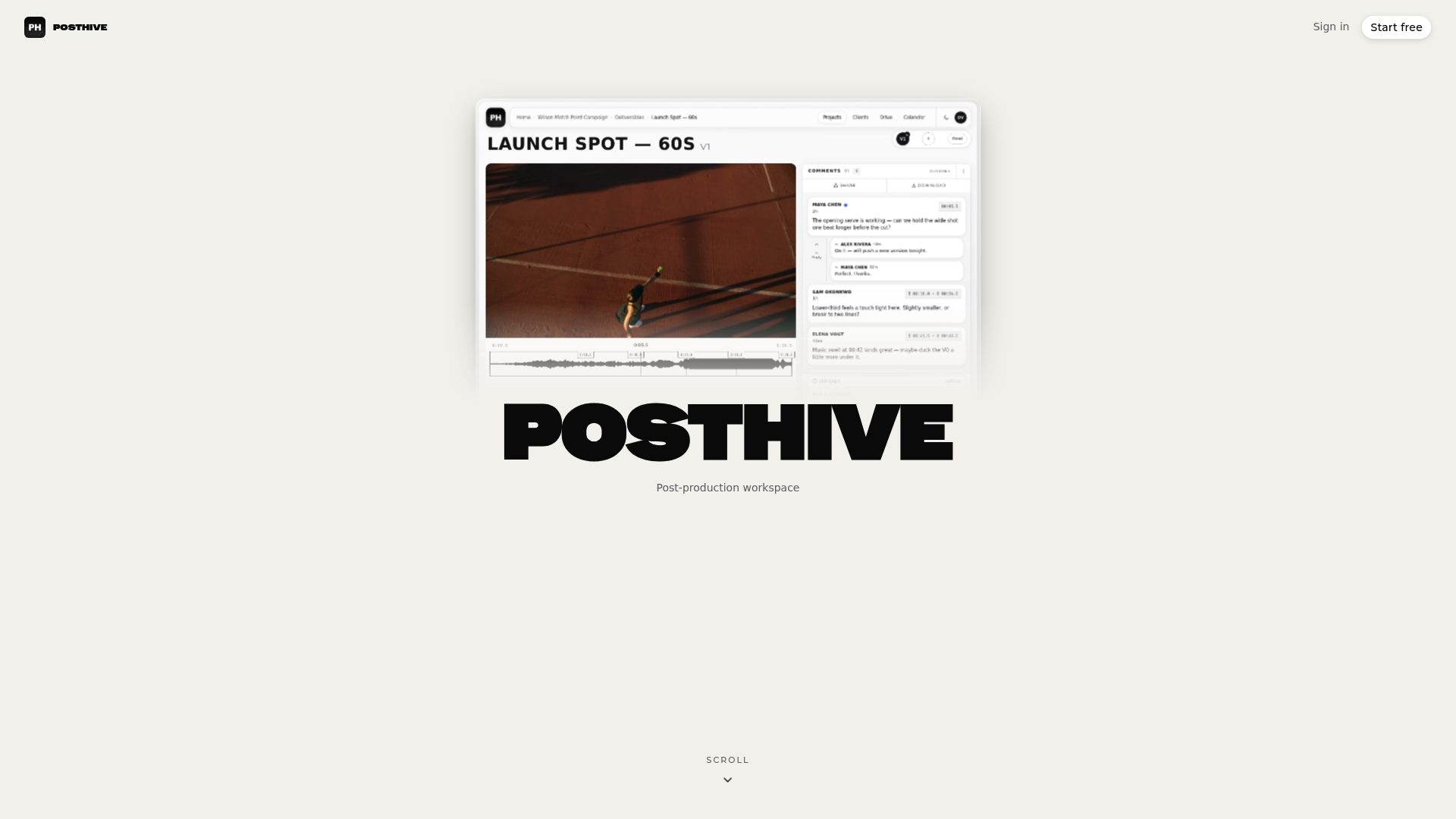
We built Posthive around the same sequence this guide walks through: version control that keeps “latest” unambiguous, review tracking that attaches feedback to the right cut, and task integration that turns an approval into a closeout trigger automatically.
- Our platform is designed to help keep ownership over deliverables and versions clear.
- Plans include multiple seats allowing reviewers and clients to join.
- Teams moving signage or event content through similar handoffs can see related workflow patterns in SignStream’s content workflow guide.
Compare our Pro and Enterprise plans to see which fits your team’s deliverable volume.
FAQ
What is considered a deliverable in project management?
A deliverable is any unique, verifiable product, result, or capability that must be produced to complete a process, phase, or project, according to PMI’s lexicon. It can be tangible, like a finished video file, or intangible, like a completed training session.
What is a project closeout checklist?
A project closeout checklist is the list of administrative and operational tasks completed after final acceptance, including contract closure, SLA handover, training, and archiving the signed acceptance record. PMI’s closing process guidance ties this directly to realizing the project’s intended return.
Which stakeholder has the ultimate sign-off decision on a project and its deliverables?
The sponsor or client typically holds final acceptance authority, though product owners or operations leads may hold it for specific deliverable types. The authority should be named explicitly in the deliverable management plan rather than assumed.
What does closing a project involve besides sign-off?
Closing a project involves administrative closure of procurements, verification that contractual obligations are met, formal acceptance, and documented lessons learned, per PMI guidance. It also includes the operational handover: training, documentation, and a maintenance plan when ongoing support is needed.
Sources
- Importance of the closing process group — PMI
- Deliverable(s) Management Plan template — CT.DSS (Deliverable Management Plan v11)