
LUFS for Broadcast: Targets, True Peak and Delivery

For broadcast, the number depends on where the program airs. US television follows ATSC A/85 at −24 LKFS with a −2 dBTP true-peak ceiling, while European television and radio follow EBU R 128 at −23.0 LUFS with a −1 dBTP ceiling. LKFS and LUFS are the same scale under two names. The streaming figures you see in music articles (−14, −16) are a different job and do not apply to a broadcast master.
The mix is only half of the work. Each deliverable also needs the right spec, the right version and a clean approval trail. That is where post-production teams lose time, and we come back to it below.
TL;DR
- US broadcast TV: ATSC A/85 targets −24 LKFS (LUFS) with a maximum true peak of −2 dBTP, for content without metadata.
- Europe, UK and most of the EBU world: −23.0 LUFS, ±1.0 LU for live, true peak no higher than −1 dBTP.
- Measure integrated loudness over the whole program, with a meter built to ITU-R BS.1770 and watch true peak separately.
- Streaming and podcasts use other targets, so a broadcast master and an online master are separate deliverables.
- Track every spec per deliverable and per version so the file that goes to air is the one that passed QC.
Table of Contents
- What LUFS actually measures
- The standard levels, market by market
- True peak and loudness range
- Broadcast versus streaming
- A practical routine for a broadcast mix
- Where loudness deliveries go wrong
- Promo: keep specs, versions and approvals in one place
- FAQ
- Sources
What LUFS actually measures
LUFS stands for Loudness Units relative to Full Scale. It is a measure of how loud audio feels, not how high its waveform peaks. Per the BBC Academy guide, the measurement averages the signal over time after a filter that approximates the ear’s frequency response. One loudness unit (LU) is equal to one decibel, so a program measured at −19 LUFS against a −23 target is 4 LU too loud. Turn it down 4 dB and it complies.
The algorithm comes from ITU-R BS.1770, now in its fifth revision (November 2023). It also defines true peak: the highest level the waveform reaches between samples, which can be higher than the largest sample value in the file.
The AES explains the steps for integrated loudness. The signal is K-weighted, split into short blocks, and the blocks that are too quiet are discarded. The rest are averaged into one number for the whole program. That is why you cannot judge compliance from a single loud scene: the number covers everything from first frame to last.

Why the meter matters
Peak meters and loudness meters answer different questions. A mix can peak at −1 dBFS and still be far louder, or far quieter, than the target. If you want a clear explanation of how the two readouts differ in a mix, see this LUFS versus dBFS comparison.
Most broadcast meters show three readings, defined in EBU Tech 3341:
- Momentary: a 400 ms window, for spotting sudden loud moments.
- Short-term: a 3 second window, for judging scenes.
- Integrated: the whole program, the figure that goes on the delivery sheet.
The standard levels, market by market
| Market / spec | Target | Tolerance | True-peak limit |
|---|---|---|---|
| US television, ATSC A/85 (2026-07) | −24 LKFS | about ±2 dB measurement tolerance | −2 dBTP |
| EBU R 128 television | −23.0 LUFS | ±0.2 LU in QC, ±1.0 LU for live | −1 dBTP |
| EBU R 128 s3 radio | −23.0 LUFS | as R 128 | −1 dBTP |
| Norway (NRK) TV delivery | −23.0 LUFS | ±1.0 LU for live | −3 dBTP recommended, QC failure above −1 dBTP |
Sources: ATSC A/85, EBU R 128, EBU R 128 s3, NRK delivery guide.
United States: ATSC A/85
The US reference is ATSC A/85, revised as A/85:2026-07 and approved on 8 July 2026. Its quick-reference table splits content into two kinds:
- Long-form (a show, a film): loudness is measured with dialogue gating, anchored on the speech.
- Short-form (a spot, a promo): loudness is measured on the full program mix, and it must not exceed the long-form content it accompanies.
For both, content without metadata targets −24 LKFS with a −2 dBTP maximum. ATSC describes A/85 as guidance for broadcasters, streaming providers and creators of television audio. For streaming delivery only, it recommends one target anywhere from −23 to −27 LKFS.
The long-form measurement is also different from the one most plugins show by default. A/85 specifies BS.1770-1 with dialogue gating, without the relative gate added in later versions. If a network gives you its own spec sheet, follow the sheet. Networks often add their own tolerances or tighter ceilings.
Europe and the UK: EBU R 128
EBU R 128 asks for a Programme Loudness of −23.0 LUFS. Live programs get ±1.0 LU where the target is not practically achievable, and QC workflows allow ±0.2 LU for measurement error. The BBC research paper WHP202 explains that −23 was chosen after a study of broadcast practice, dynamic-range tolerance and transmission technology. It also notes that −23 LUFS corresponds to a Dolby dialnorm value of 23.
Radio uses the same level. EBU R 128 s3 recommends producing radio programs at −23.0 LUFS with true peak at or below −1 dBTP. The BBC radio specification asks for the same figures, with pre-records delivered as 48 kHz, 16-bit WAV or BWF files (FLAC is also accepted).
Other markets move too
Standards get revised. Japan’s ARIB TR-B32 reached version 1.7 on 10 September 2026 to cover loudness management across multiple media, including internet distribution. If you deliver abroad, ask for the current spec sheet rather than relying on last year’s number.
True peak and loudness range
Integrated loudness is one of three numbers a QC report checks.
True peak. The limit stops converters and codecs from clipping after delivery. Under EBU R 128, a meter that complies with BS.1770 and Tech 3341 should show no more than −1 dBTP, with ±0.3 dB measurement tolerance. ATSC’s −2 dBTP is stricter. Norway’s guide recommends −3 dBTP and fails files above −1 dBTP. Lower ceilings can apply to specific distribution systems, so a mix that passes one spec can fail another.

Loudness range (LRA). This describes how much loudness varies across a program. EBU R 128 recommends using LRA, measured to Tech 3342, to evaluate variation. It sets no single universal limit. The NRK guide, for example, gives guidance of no more than 18 LU. Check your own destination for a number.
One target, on purpose. The EBU’s production guidelines, Tech 3343 argue that a string quartet and a symphony should both land at −23 LUFS integrated. The aim is to make programs fit alongside their neighbors in the schedule, not to reproduce real sound-pressure differences. Allowing genre-based variations, they warn, would bias the system toward louder. The AES adds that loudness management does not mean everything sits at the same level: dynamics inside the program are still part of good mixing.
Broadcast versus streaming
A broadcast master is not an online master. EBU R 128 s2 recommends streaming programs unchanged at −23.0 LUFS when correct loudness metadata is present. Without metadata, it suggests an interim −18.0 LUFS, or −16.0 LUFS for mostly music programs. The November 2023 revision of R 128 s3 adds that mobile devices now have enough headroom and gain, so streaming need not be treated differently from broadcast.
The AES points out that different ecosystems with different targets are themselves a problem, which is why it publishes TD1005, TD1006 and TD1008 and the AES 71 standard for online distribution.
For your workflow, the practical rule is simple: if a project goes to air and to the web, treat those as two deliverables with two loudness specs. Podcasts and music platforms have their own targets again, so look up the platform’s current published figure before you export.
A practical routine for a broadcast mix
- Get the spec first. Ask the broadcaster for its delivery sheet: target, tolerance, true-peak ceiling, file format, sample rate, and whether it wants dialogue-gated or full-mix measurement.
- Mix with a loudness meter open, set to the right standard, showing momentary, short-term and integrated readings.
- Measure the whole program from first to last frame, including bars, slate and silence rules if the spec has them. Integrated loudness is a whole-file number.
- Correct with gain, not guesses. If you measure −21.5 and need −23, take 1.5 dB off the program. A level offset of this kind does not change the dynamics.
- Check true peak last, after any limiting or gain change, with a true-peak meter.
- Export, then re-measure the exported file. The bounce is what the broadcaster tests, not your session.
- Save the measurement report with the file, so a QC rejection can be traced to a version.
The loudness step is only one gate in a longer chain. If you want the full sequence from ingest to archive, our post-production checklist covers it.
Where loudness deliveries go wrong
Most rejections are not mixing mistakes. They are version mistakes:
- The mix passed at −23, then the client asked for a line change, and an older bounce went out.
- A US network version (−24 LKFS, −2 dBTP) and a European version (−23 LUFS, −1 dBTP) sit in the same folder with similar names.
- A short-form spot was balanced on its own and plays louder than the long-form program it sits beside.
- Feedback arrives by email and chat, and nobody can say which note belongs to which cut.
These are workflow problems. A clear name per deliverable, a spec noted against each, and one place where the client approves the exact version prevent most of them.
Promo: keep specs, versions and approvals in one place
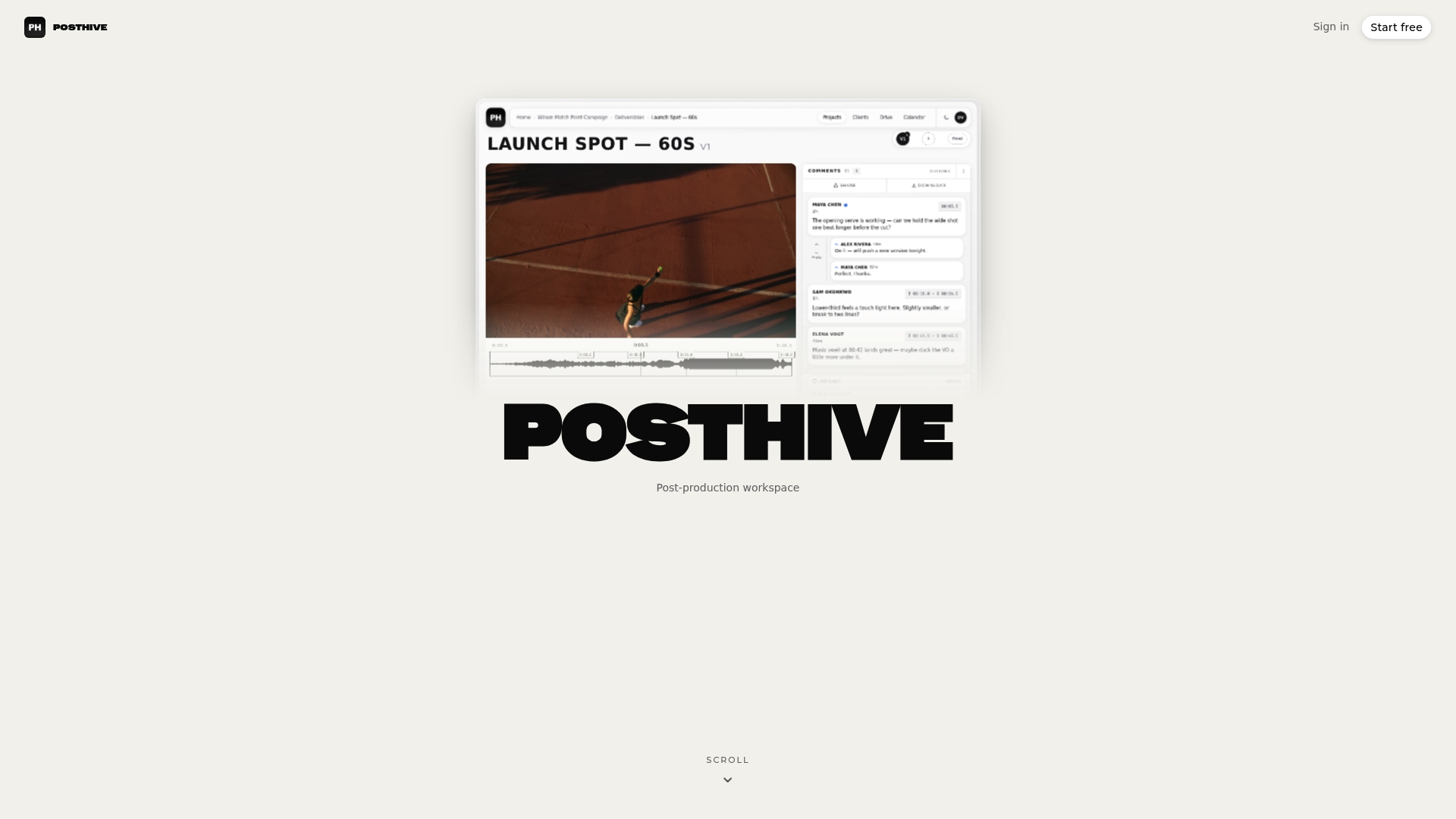
Posthive is a cloud post-production workspace with version control, task and deadline tracking, collaborative review, client feedback and approval tracking, and secure media delivery. In practice that means each deliverable can carry its own versions and its own review trail, so the approved mix is the one that gets delivered. Clients keep ownership of their deliverables and versions, and every plan includes unlimited free seats, so your client and your whole team can be in the project without paying per editor.
There are free, Pro ($49 per month) and Enterprise ($99 per month) plans, with different storage and feature tiers. Posthive also integrates with Google Calendar and offers plugins for NLEs (non-linear editors, the software used to cut picture). See the plans on the pricing page or start from the Posthive home page.
Perspective: a spec is only useful if the right file carries it
We build Posthive for creative teams, and the same pattern keeps coming up in broadcast work: the loudness number is easy, the bookkeeping is hard. A −24 LKFS mix with the wrong cut attached is still a rejected delivery.
That is why we think the deliverable, not the folder, should be the unit of work. Each one has a version history, a deadline, a reviewer and an approval. The client owns the result and sees exactly what was signed off. Because we do not charge per seat, the sound mixer, the editor, the producer and the client can all work in the same project instead of passing files by email.
Loudness standards will keep being revised, as ATSC and ARIB did in 2026. Teams that track the spec per deliverable can adapt without rebuilding their process.
Lorenz
FAQ
What is the standard LUFS level for broadcast?
It depends on the market. US television under ATSC A/85 targets −24 LKFS for content without metadata, with a −2 dBTP maximum true peak. EBU R 128 markets, including most of Europe, use −23.0 LUFS with −1 dBTP. Always confirm with the broadcaster’s own delivery sheet.
Are LUFS and LKFS the same?
Yes for practical purposes. Both name a K-weighted loudness measurement referenced to digital full scale under ITU-R BS.1770. Europe says LUFS, ATSC documents say LKFS, and one loudness unit equals one decibel in both.
How much tolerance do I get?
EBU R 128 allows ±1.0 LU for live programs where the target is not practically achievable, and ±0.2 LU in QC for measurement error. ATSC A/85 anticipates a measurement tolerance of up to about ±2 dB. Individual broadcasters may set tighter limits, so check their spec.
Can I use my streaming master for broadcast?
Not without re-measuring it. Streaming masters are commonly set louder than broadcast targets and may exceed the true-peak ceiling. Treat the broadcast and online versions as separate deliverables, each measured against its own spec.
Sources
- Why is loudness such an issue for TV viewers? (BBC Academy)
- Recommendation ITU-R BS.1770-5 (11/2023)
- Loudness Basics (AES)
- Loudness (EBU)
- ATSC A/85:2026-07 Annex M
- ATSC A/85 overview page
- EBU R 128 v5.0
- EBU R 128 s3, Loudness in Radio
- EBU R 128 s2, Loudness in Streaming
- EBU Tech 3343 production guidelines
- BBC R&D White Paper WHP202
- BBC radio technical specification
- NRK audio delivery guide for TV
- ARIB TR-B32 overview