Post-Production Calendar Template: Timeline Plus Folder Rules
Post-Production Calendar Template: Timeline Plus Folder Rules

Use a shared post-production calendar template that combines a week-by-week phase timeline, named owners, and deliverables tracking, and you can lock a realistic delivery date before you shoot a single frame. For most productions, that means a template built around monthly and weekly views with fixed delivery markers and visible capacity limits, not a static list of due dates nobody updates.
Grab it in whichever format your team already lives in: Google Sheets for fast, portable editing, Excel for studios with locked-down IT policies, Airtable/CSV for relational views with linked assets, or a Notion export if your team already tracks documents alongside tasks. A workspace like Posthive can also host the calendar directly, syncing it with version control and approvals instead of leaving it as a dead file in a shared drive.
The benchmarks that should anchor your dates: editorial typically runs 2 to 4 weeks per hour of finished runtime for straightforward narrative work, and sound design plus mixing usually adds another 3 to 6 weeks on top, according to Tools for Film’s post-production estimator. A 90-minute feature with a clean cut and no unusual VFX load typically requires several months for editorial alone, before color, sound, and deliverables like a DCP (digital cinema package) get added to the calendar.
- Downloadable formats to grab first: Google Sheets, Excel (.xlsx), Airtable/CSV, Notion export
- Core benchmark to remember: editorial = 2 to 4 weeks per hour of runtime
- Fixed-week add-ons: color grading, sound mix, and delivery each get their own block, not a shared guess
- Best home for execution: a workspace like Posthive that keeps owners, versions, and approvals in one place
Quick benchmark: A feature with moderate VFX and multiple delivery formats often requires several months from locked picture to final delivery, accounting for color, sound, and QC passes counted separately from the edit.
Key Takeaways
A realistic post-production calendar pairs industry-benchmarked phase durations with named owners, locked folder structure, and a workspace that enforces version control instead of hoping everyone checks the same email thread.
| Point | Details |
|---|---|
| Pick the right format | Use spreadsheets for speed, Airtable or an app template for dependencies and approvals. |
| Run a timeline estimate first | Base your schedule on runtime and VFX shot count, not last project’s guess. |
| Assign owners and buffers | Every phase row needs a named owner and at least one buffer week built in. |
| Enforce folder structure | Standardized naming prevents the version mix-ups that stall deliveries. |
| Move execution into Posthive | Import the template, sync approvals, and export deliverables from one workspace. |
Book your colorist and sound mixer against the estimate as soon as it’s built, not after editorial finishes. Both specialists get booked out weeks in advance, and a calendar built too late to reserve their time is a calendar that’s already behind.
Table of Contents
- Which Post-Production Calendar Template Format Fits Your Team?
- What Belongs in a Post Production Schedule Template?
- How Do You Set Up a Post-Production Calendar Template?
- How Long Does Each Post-Production Phase Actually Take?
- What Should a Post-Production Timeline Estimator Calculate?
- What Are the Most Common Post-Production Scheduling Mistakes?
- What Collaboration Features Actually Reduce Delivery Risk?
- What’s Included in the Downloadable Template Bundle?
- How Post Supervisors Actually Run These Calendars Day to Day
- How Posthive Turns Your Template Into a Working Schedule
- Sources
Which Post-Production Calendar Template Format Fits Your Team?
The right format depends less on personal preference and more on team size, how many vendors you coordinate, and whether approvals need to happen inside the same tool as the schedule.
Google Sheets and Excel are the fastest way to get a working calendar today. You can drop in phase rows, color-code status, and share a link in five minutes. The tradeoff is that spreadsheets don’t track file versions or route approvals, so someone still has to chase sign-offs by email.
Airtable treats your calendar as a relational database instead of a flat grid, which matters once you’re linking VFX shots to specific scenes or tracking multiple deliverables against one master timeline. It’s the strongest free option for productions juggling more than 50 tasks with real dependencies.
Notion works best for teams that already keep scripts, notes, and reference documents in the same tool as their task lists. The calendar view sits next to your bible and continuity notes instead of living in a separate app.
App-based templates, including calendar tools with built-in review workflows, add the piece spreadsheets miss: version history, comment threads tied to specific cuts, and approval status that updates automatically. Monday and similar tools popularized the Gantt-plus-calendar combination that most modern post workflows now expect.
| Format | Best for | Collaboration strength | Setup speed |
|---|---|---|---|
| Google Sheets / Excel | Small edits, solo editors | Low (manual sharing, no version control) | Fastest |
| Airtable | Multi-vendor projects with dependencies | Medium (linked records, filtered views) | Moderate |
| Notion | Teams already documenting in Notion | Medium (docs + tasks together) | Moderate |
| App template (Gantt/Calendar/Kanban) | Feature-length or episodic post with approvals | High (version control, approval routing) | Slower to configure, faster to run |
Gantt views suit anyone managing overlapping VFX and sound work across a long schedule. Calendar views work better for smaller teams who care more about “what’s due this week” than dependency chains. Kanban fits teams running frequent short-form deliverables, like weekly branded content, where status (not date) is the primary organizing question.
What Belongs in a Post Production Schedule Template?
A calendar that only lists “Edit” and “Deliver” isn’t a schedule, it’s a wish. Every functional post production schedule template needs phase-level rows and metadata fields attached to each task, not just start and end dates.
Phase rows should cover:
- Editorial: assembly cut, rough cut, director’s cut, client/network cuts, locked picture
- VFX: shot list, asset builds, render passes, VFX review
- Color: conform, grade, client color review
- Sound: design, ADR, mix, final QC
- Music: composition or licensing, delivery of stems
- Deliverables: DCP, streaming masters, broadcast masters, closed captions
- Marketing and approvals: trailer cuts, poster stills, legal/clearance sign-off
Each row also needs metadata that tells you who’s accountable and what’s blocking progress. A standardized post-production workflow template built around folder structure and document tracking cuts down on the version-control confusion that derails handoffs between departments.
| Field name | Purpose | Example value |
|---|---|---|
| Owner | Names the person accountable for the task | J. Alvarez, Colorist |
| Start date | Marks when work can begin | March 3, 2026 |
| End date | Sets the delivery target for that task | March 2026 |
| Status | Shows current progress at a glance | In Review |
| Dependencies | Flags what must finish first | Locked picture required |
| Revision count | Tracks how many passes have occurred | Rev 3 of 4 max |
| File path | Points to the current asset location | /Post/Color/V3/ |
| Approval owner | Names who signs off before the next phase | Producer, K. Simmons |
Naming conventions matter as much as the fields themselves. A folder tree like /Project_Name/Phase/Version/ with consistent version tags (V1, V2, FINAL) keeps deliverables from getting mixed up when three vendors are sending files the same week.
How Do You Set Up a Post-Production Calendar Template?
Setting up the calendar is a one-session job if you have your runtime, deliverables list, and team roster ready before you start.
- Create the project shell. Name it, set the target delivery date, and list every required deliverable format (DCP, streaming master, broadcast master, trailer).
- Set runtime and complexity inputs. Enter total runtime, estimated VFX shot count, and grading complexity so your timeline estimate reflects the actual project, not a generic guess.
- Run a timeline estimate. Use benchmark ranges (2 to 4 weeks per hour for editorial, 1 to 3 weeks for color, 3 to 6 weeks for sound) to generate a first-pass week-by-week schedule.
- Assign owners to every phase row. No task should sit without a named person accountable for it.
- Import your folder structure and asset paths. Attach the standardized folder tree so file paths in the calendar match where assets actually live.
- Schedule review sessions in advance. Block dailies, VFX review, and color sessions on the calendar before the phase begins, not after work is already late.
Dependencies matter more than most schedules admit. Sound design can start before editorial fully locks, working against a near-final cut, but the final mix should wait for locked picture. VFX teams can begin work on scenes that are locked early, even while other scenes in the same reel are still being recut.
Pro Tip: Cap revisions at three rounds per deliverable and build one buffer week into every major phase transition. Productions that skip buffers are the ones asking for a mix extension two days before the festival deadline.
Once the calendar is built, sync it into a shared workspace rather than keeping it as a static file. Posthive’s calendar integration lets a schedule built from a spreadsheet template continue live inside the same tool where approvals and version history already happen.
How Long Does Each Post-Production Phase Actually Take?
Timing benchmarks only work as guardrails, not guarantees, but they’re the difference between a schedule grounded in reality and one built on hope.
Editorial commonly runs 2 to 4 weeks per hour of runtime for straightforward narrative cutting. A single-camera drama with clean dailies moves faster; a documentary with hundreds of hours of footage and a loose structure moves slower, sometimes well past that range.
VFX scales with shot count and complexity rather than runtime. Ten simple shots, like basic screen replacements or color-safe cleanup, might take 1 to 2 weeks. Ten complex CG shots can eat 4 to 8 weeks. A film with 200 VFX shots split across simple and complex work needs its own dedicated timeline, layered against the edit rather than tacked on at the end.
Color grading generally takes 1 to 3 weeks for a feature, and sound design plus mixing runs 3 to 6 weeks. Music scoring or licensing adds another 2 to 4 weeks, often running in parallel with picture lock rather than after it. Final deliverables, including a DCP and streaming masters, typically add 1 to 2 weeks once picture and sound are approved.
Overlap is where realistic schedules separate from optimistic ones. Sound can begin against a near-final cut. VFX can start on scenes that are locked early. Color review can happen in parallel with final sound QC. Locking picture too late is what collapses all of that overlap into a single panicked month.
Editor, colorist, and mixer capacity should get booked based on the estimate, not adjusted after the fact. A production planning calendar with visible capacity indicators makes it obvious when a colorist is double-booked across two projects before it becomes a crisis in week three.

What Should a Post-Production Timeline Estimator Calculate?
An estimator turns four inputs into a defensible delivery date instead of a guess pulled from the last project’s schedule.
Gather these before you run one: total runtime, estimated VFX shot count broken into simple and complex categories, grading complexity (standard grade versus heavy VFX-integrated grade), and your full deliverables list.
The Tools for Film timeline estimator calculates phase durations from those inputs and outputs a week-by-week schedule, applying overlap rules where they’re realistic, sound starting before lock, VFX running on already-locked scenes, rather than stacking every phase end to end.
Here’s what that output looks like for a 90-minute feature with moderate VFX (around 80 shots, mostly simple to medium complexity) and three deliverable formats:
| Week range | Phase | Notes |
|---|---|---|
| Weeks 1–8 | Editorial (assembly through locked picture) | Client cuts reviewed in weeks 5–6 |
| Weeks 4–12 | VFX (overlapping locked scenes) | Starts once first scenes lock |
| Weeks 9–10 | Color grading | Begins after picture lock |
| Weeks 6–12 | Sound design and mix | Starts against near-final cut |
| Weeks 12–14 | Music delivery | Runs parallel to final sound mix |
| Weeks 14–16 | Deliverables (DCP, streaming, broadcast masters) | QC pass included |
That puts total post at roughly 16 weeks from first assembly to delivery, which tracks with the idea that post-production timelines are frequently underestimated when producers skip the overlap math entirely.
Treat every number here as a starting point. A team that revises rough cuts five times instead of two will blow past these ranges regardless of what the estimator says, and a fast-turnaround unscripted show can beat them by weeks.
What Are the Most Common Post-Production Scheduling Mistakes?
Most delivery disasters trace back to the same handful of scheduling errors, and nearly all of them are avoidable with a template that enforces structure instead of hoping the team improvises well.
Leaving post open-ended is the most common one. Without a target delivery date locked before photography wraps, every department treats its phase as flexible, and flexible phases always expand.
Underestimating VFX complexity is a close second. Producers often price and schedule VFX by shot count alone, ignoring that ten complex CG composites take four times longer than ten simple cleanup shots.
Not booking colorists and mixers early enough causes real damage. These specialists work on multiple projects and get booked months out. A calendar built after the fact, instead of one used to reserve capacity in advance, routinely finds the best colorist already committed elsewhere.
Skipping folder standards and version naming creates the kind of chaos where nobody knows if Scene12_v3_FINAL_v2.mov is actually final. That single naming failure has derailed more festival deliveries than any creative disagreement.
Best practice is to calculate the post-production timeline by project complexity, factoring in VFX shot counts and grading demands, before principal photography wraps. That’s the window where editors, colorists, and sound mixers can still be booked against a realistic date instead of squeezed in after the fact.
Red flags to check on any calendar before you trust it: a deliverable with no assigned owner, two critical review sessions scheduled back to back with zero buffer between them, and a VFX vendor with no locked scenes assigned to them yet three weeks into the schedule. Catch those in the setup phase, not the week before delivery.
What Collaboration Features Actually Reduce Delivery Risk?
The calendar template gets you organized. The workspace you run it in determines whether that organization survives contact with fifteen people sending files at once.
The features that matter most: versioned file storage so nobody overwrites a colorist’s grade with an old cut, review and approval tools that route sign-offs automatically instead of by email chain, task assignments tied to actual calendar dates, Gantt and calendar sync so the same schedule shows up in every view your team prefers, secure media delivery for formats like DCP and streaming masters, and an audit log showing who approved what and when.
These features change the daily experience of running post. Approvals that used to take three days of forwarded emails happen in one review pass. Version-control errors, the kind where someone delivers V2 when V4 was approved, drop close to zero when every file lives under one version history instead of scattered across drives and inboxes.
A calendar is only as reliable as the workspace enforcing it. The best template in the world still fails if approvals happen in email and files live in six different folders across three drives.
Posthive was built around this exact gap: import your calendar template, assign owners against real deadlines, run review passes with version history intact, and export finished deliverables, including DCP packages and streaming masters, without leaving the workspace. Production teams using it get one place where the schedule, the files, and the approvals all agree with each other.
What’s Included in the Downloadable Template Bundle?
The bundle covers the formats most post teams already work in, so you’re not stuck converting file types before you can start.
Files included: a Google Sheet with pre-built phase rows and formulas for date calculations, an Excel .xlsx version for locked-down IT environments, an Airtable CSV import for relational tracking, a Notion template export for doc-plus-task teams, and a sample Posthive project link showing the calendar running inside a live collaborative workspace.
Importing each one takes a few minutes:
- Google Sheets: File > Make a Copy, then adjust the project name and delivery date in row one.
- Excel: Open the .xlsx directly, enable editing, and update the deliverables list in the summary tab.
- Airtable: Create a new base, import the CSV, then map columns to Owner, Status, and Dependencies fields.
- Notion: Use “Duplicate” on the shared template link to add it to your workspace, then adjust database properties to match your phases.
- Posthive: Open the sample project link, duplicate it into your own workspace, and start assigning owners against your actual dates.
For a two-person editing team, start with the Google Sheet, it’s fastest to adjust and requires no learning curve. For a feature with multiple vendors and formal approvals, start with Airtable or Posthive, since both handle dependencies and version tracking that a flat spreadsheet can’t.
Save your customized version as a reusable master once you’ve adjusted field names and folder paths to match your standard workflow. That saves the setup time on every future project.
How Post Supervisors Actually Run These Calendars Day to Day
The calendar earns its keep in the small daily moments, not just the big milestone dates. A post supervisor checking the schedule each morning is really checking three things: what’s due this week, what’s blocked, and who hasn’t updated their status in two days.
Weekly cadence usually follows a rhythm: dailies review on Monday, a VFX sync midweek to confirm which shots are ready for the next render pass, and a color review session scheduled for whenever picture actually locks, not whenever the calendar originally guessed it would. That flexibility only works if the underlying dependencies are set correctly, so a delayed lock automatically pushes color and sound rather than leaving three departments guessing.
The crises that get averted are almost always version-control crises. A sound mixer working from an outdated cut because nobody flagged the new lock date. A VFX vendor rendering a shot that got recut two days earlier. Folder rules and a shared calendar don’t eliminate these problems entirely, but they cut the frequency dramatically, because everyone is checking the same source of truth instead of five different email threads.

Handoffs between departments work best when the outgoing team leaves a short note with the delivery, not just a file. “Locked scene 14, VFX ready to start, sound needs updated dialogue stems by Friday” takes ten seconds to write and saves a half day of back-and-forth guessing.
How Posthive Turns Your Template Into a Working Schedule
Once you’ve picked a format and filled in the phase rows, the real work is keeping that calendar accurate as fifteen people touch it over sixteen weeks. Posthive imports the template you’ve already built, lets you assign owners against real deadlines, and routes review passes so approvals happen inside the same tool where the files live.
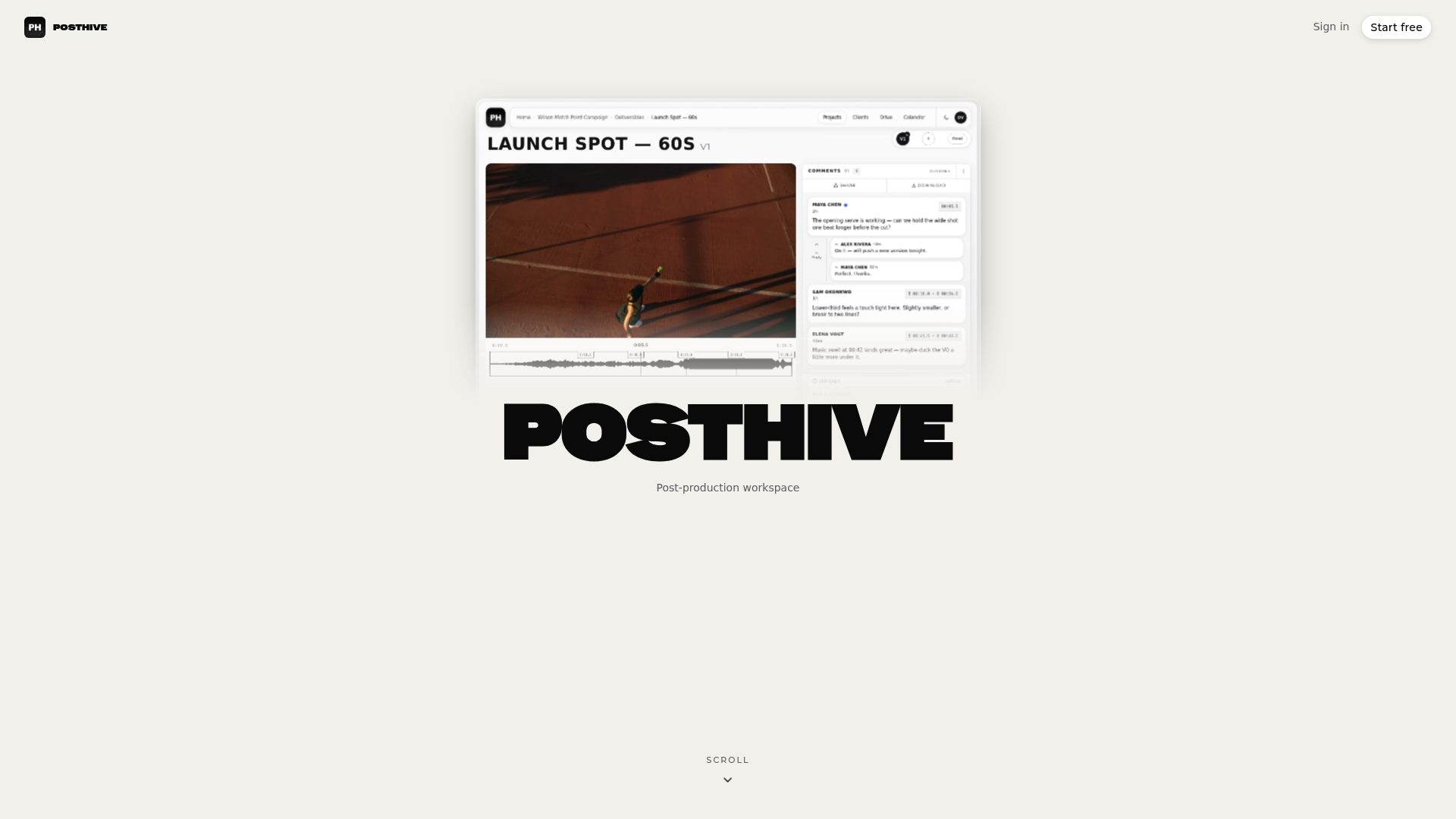
Instead of chasing sign-offs over email or hunting for the latest version across scattered drives, your team works from one calendar that stays synced with version history, task status, and delivery packages, including DCP exports and streaming masters, in a single workspace. When picture locks two days late, dependencies shift automatically instead of requiring a manual update across five different files.
Start by duplicating the sample project inside Posthive and mapping your own phase rows, owners, and deliverables onto it. Coordinating with an outside editing vendor first? Videography and editing partners can slot directly into the same calendar so external work stays visible alongside your internal team’s progress. From there, you’re one review pass away from a delivery schedule that actually holds.
Sources
- Post Production Timeline Estimator - Free Filmmaking Calculator | Tools for Film
- Production Planning Calendar | Manufacturing Templates - Karygar