Bid to Delivery Resource Planning for Scalable Post Production Teams
Bid to Delivery Resource Planning for Scalable Post Production Teams

Post-production resource planning means mapping every editor, suite, render license, and review slot a project needs before work starts, then locking that plan into a shared schedule. The single best action is to block named resources and record them in a shared calendar the moment a bid is accepted. Teams that do this see fewer double-bookings, more predictable delivery windows, and fewer billing disputes over overages.
TL;DR:
- Assigning named resources for suites, personnel, and review sessions in advance helps prevent double-bookings and ensures predictable delivery timelines.
- Tracking late approval responses, overdue tasks, and capacity limits through visual cues and audits allows early detection of schedule conflicts and bottlenecks.
- Locking the bid-defined deliverables and version counts into the schedule ensures enforceable commitments and proper handling of overages with written approval.
- Software should integrate calendar booking, version control, review workflows, and permissioning, with conflict detection and templates to streamline scheduling.
- Fixing one major bottleneck identified through a project audit typically improves schedule accuracy more effectively than extensive workflow overhauls.
Table of Contents
- What post-production resource planning covers
- Common challenges that break schedules and how to spot them early
- Step-by-step post-production scheduling: six actions to protect resources
- What to look for in post-production scheduling and resource software
- Contracts, bids, and overages: practical rules that affect bookings
- Practical templates and workflow examples you can adopt
- Scale thoughtfully, one control at a time
- Posthive as an option for scalable post-production teams
- Sources
- FAQ
What post-production resource planning covers
Resource planning spans four categories, and treating any one of them informally creates risk. Human resources include editors, colorists, mixers, and assistants, each with limited hours per day. Physical facilities cover edit bays, color suites, and audio booths, which can only host one project at a time. Digital resources include cloud storage, render farm time, and software licenses, all of which run out faster than most schedules assume. Review sessions, often treated as an afterthought, need their own calendar slots because clients and stakeholders rarely approve work on the first pass.
Someone needs to own each booking category, and that ownership should be named, not assumed. A post-production manager typically owns suite and personnel bookings; a producer or project lead owns review session scheduling and client communication.
- Human resources: editors, colorists, mixers, sound designers, assistants
- Physical resources: edit suites, color bays, mix stages, recording booths
- Digital resources: storage allocation, render queues, software seats
- Review resources: client approval sessions, internal QC passes
Resource definitions and version specs belong in the bid itself, not just the internal schedule, because a bid that names deliverables and revision counts is the document that makes a later booking enforceable.
Common challenges that break schedules and how to spot them early
Most post-production delays trace back to a small set of repeating failures. Catching them early is far cheaper than fixing them after a client notices a missed date.
- Double-booking a suite or editor across two projects with overlapping deadlines
- Approval delays where a client or stakeholder sits on a cut for days without a defined response window
- Version sprawl, where multiple cuts circulate without a clear naming or lock convention
- Storage or render capacity running out mid-project, stalling delivery
- Burnout from stacking overtime on the same one or two team members project after project
To catch these before they cascade, watch a handful of operational indicators: how often overtime gets logged, what percentage of work requires rework after review, and how frequently overage requests come in at the last minute. A spike in any of these usually points to a scheduling gap rather than a skills gap.
Two detection tactics work well without heavy tooling. First, apply conditional formatting to a shared calendar so any resource booked past a set threshold, for instance more than eight hours in a day, highlights automatically. Second, run a single-project trace audit: follow one recent job from ingest to delivery and mark every point where it waited on a person, suite, or approval. That one audit usually reveals the actual bottleneck faster than a full workflow review.
Pro Tip: Run the trace audit on your most recent delayed project first. Delays repeat patterns, so last month’s bottleneck is probably still active.
Step-by-step post-production scheduling: six actions to protect resources
A workable schedule gets built in a specific order, and skipping steps is what causes the double-bookings and rework covered above.
- Plan resource use during pre-production, before the bid goes out, and list deliverables and expected version counts in that bid
- Map the critical path, which is the sequence of tasks that directly determines the delivery date, and lock milestone dates with the full team
- Assign named personnel and named suites rather than role placeholders, and post those bookings on a calendar everyone on the project can see
- Define approval windows with a hard response deadline and a version-lock rule once a cut moves past a given stage
- Parallelize only the tasks that do not depend on each other, and write down which steps must happen in sequence
- Schedule quality control with a built-in time buffer and a final sign-off slot, so a last-minute fix never collides with the delivery deadline
A few habits make this easier to sustain across multiple projects:
- Use one shared calendar for all suite and personnel bookings, not separate spreadsheets per project
- Name the approver for each review stage in the project plan itself
- Build in at least one buffer day before final delivery for every project with more than two review rounds
- Flag any task waiting on a client response as “pending,” not “in progress,” to keep the critical path accurate
Parallel work only saves time when dependencies are mapped correctly. Color and sound mix can often run in parallel once picture is locked, but QC has to wait until both are finished, which is why the final QC slot needs its own protected window rather than sharing time with the mix.
What to look for in post-production scheduling and resource software
The right software should match the steps above, not add a separate layer of work on top of them. A handful of features matter more than the rest when comparing options.
- Suite and equipment booking tied to actual calendar dates, not a generic task list
- Named-resource allocation so a booking shows a specific editor or suite, not just a role
- Calendar and NLE integration so bookings sync with the tools editors already use
- Version control that tracks who made each change and when, without manual file renaming
- Review and approval workflows with built-in deadlines and notification triggers
- Permissioning that lets clients see and approve deliverables without exposing internal project files
Beyond the core list, a few time-saving features separate a tool that gets adopted from one that gets ignored: templates for recurring booking patterns, automatic conflict detection when two bookings overlap, status notifications that fire without a manual update, and calendar templates that import directly rather than requiring manual setup.
Security deserves specific attention now that generative AI tools touch more deliverables. AICP guidance recommends closed-system AI use, prompt archiving, and clear contract language whenever AI tools contribute to a deliverable, and any software evaluation should check whether the platform supports those safeguards.
Pro Tip: Before adopting new software, test conflict detection with a deliberately overlapping booking. If the system catches it instantly, it will catch real conflicts too.
Contracts, bids, and overages: practical rules that affect bookings

A bid is not just an estimate. Under AICP guidelines, a post-production company’s accepted bid becomes the minimum contract price, which means the time it represents has effectively been sold and should be scheduled with that weight. Overages need written confirmation, not a verbal nod, though AICP acknowledges verbal approval is binding in urgent cases if it is promptly followed up in writing. Treating booked time this way also protects against cancellations, since a held slot represents an agreement not to resell that time to another client.
A few contract items are worth adding directly to bids and purchase orders:
- A named approver for any overage request, so time isn’t spent chasing signatures mid-project
- A defined cancellation window with associated fees for booked but unused time
- A payment schedule such as the 50-25-25 or 50-50 structures AICP cites as examples
- A notification procedure specifying how and when overage requests get raised and confirmed
Practical templates and workflow examples you can adopt
A post-production calendar template built around fields for resource name, project, start and end time, and approval status gives every booking the same shape, which makes conflicts visible at a glance. Folder structures should follow a fixed naming convention tied to version number and lock status, which is covered in more detail in a guide to video version control.
A simple walkthrough: block the edit suite and editor first, then color and mix as parallel bookings once picture locks, each with its own named resource and approval window, then a final QC slot with a buffer day before delivery.
- Trace one recent project end to end to find its single biggest bottleneck
- Add one automated status update around that bottleneck before changing anything else
- Treat suites and equipment as finite assets, scheduled with the same care as personnel
| Workflow stage | Resource type | Key control |
|---|---|---|
| Rough cut | Editor, edit suite | Named booking on shared calendar |
| Color and mix | Colorist, mixer, suites | Parallel booking once picture locks |
| Client review | Stakeholders | Fixed approval window |
| Final QC | QC reviewer | Buffer day before delivery |
A broader post-production workflow guide covers how these pieces fit together across longer-running projects.
Scale thoughtfully, one control at a time
The instinct when a schedule breaks is to overhaul the whole workflow. That instinct is usually wrong. A single trace audit on one recent project tells you more about where time actually leaks than a full platform migration does, and it costs almost nothing to run. Fix the one bottleneck it surfaces, measure the result with a plain KPI such as overage rate, number of double bookings, or time-to-approval, and only then decide whether a bigger change is worth the disruption. Most teams find the first fix solves more than they expected.
— Lorenz
Posthive as an option for scalable post-production teams
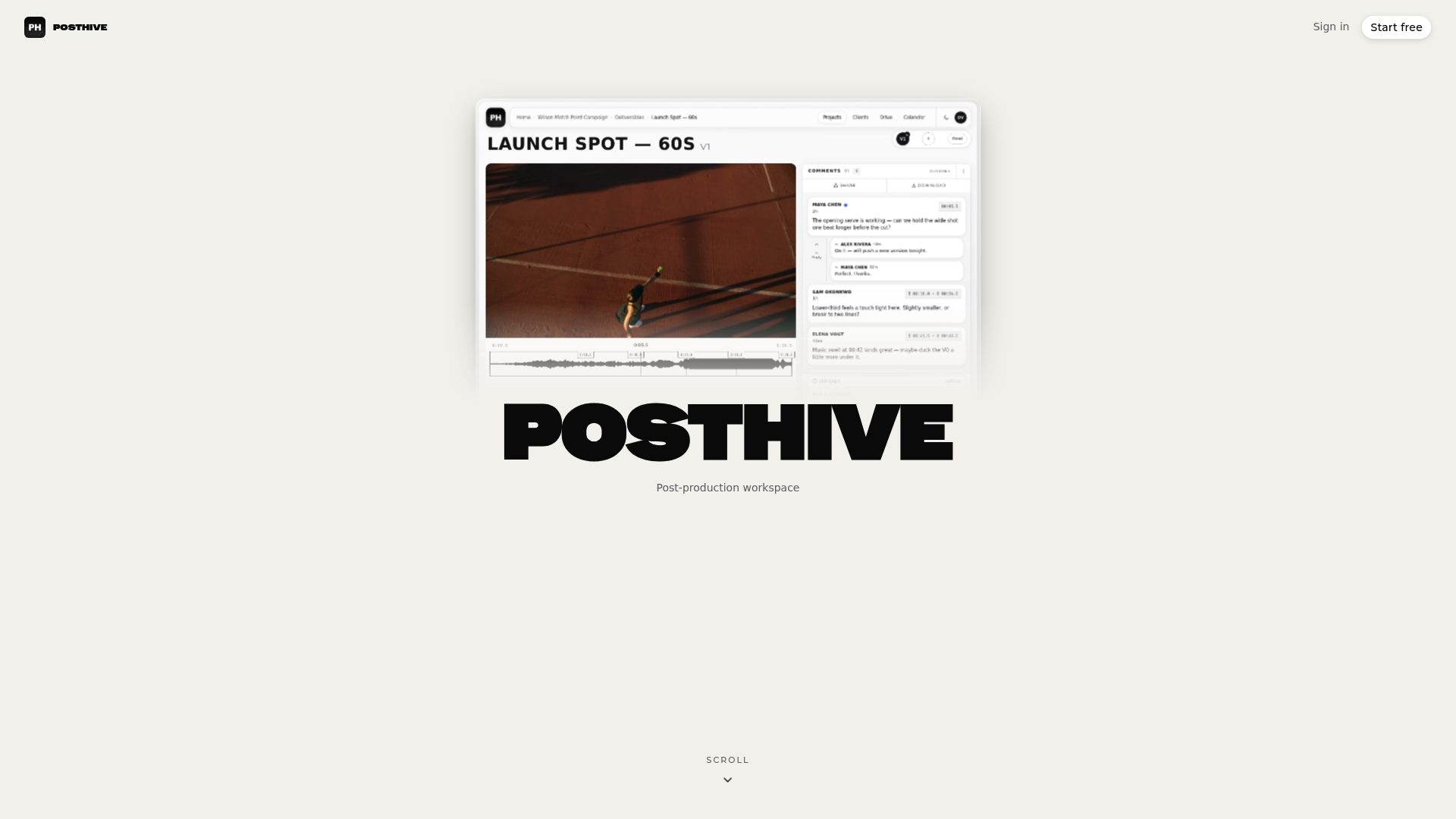
The practices above, named-resource booking, version locking, visible calendars, work best with a system built to hold them. Posthive offers unlimited seats on every plan, allowing team members and clients to access review and approval functionality without per-editor fees. Version control keeps deliverable ownership with the client while the team tracks changes underneath, and calendar integration with Google Calendar means bookings made in Posthive show up where editors already look.
A few ways to start without a full rollout:
- Import the calendar and folder template for your next project
- Test the calendar integration against one active production
- Review plan details on the Posthive pricing page for current pricing information.
For teams comparing broader feature sets first, the productivity page outlines how task tracking and version control work together before you commit to a plan.
Sources
- AICP Post Production Guidelines (Post_Production_Guidelines_032522_FINAL.pdf)
- AICP - Guidelines and best practices - Post Production
FAQ
What are the three phases of post-production?
Post-production generally moves through editing, which includes picture lock, then finishing, which covers color and sound mix, then delivery, which includes quality control and final export. Each phase depends on the one before it, which is why locking picture before starting color and mix matters for scheduling.
What are the five main types of production planning?
Definitions vary by studio, but a common breakdown includes pre-production planning, resource and budget planning, scheduling and critical path planning, risk and contingency planning, and delivery or QC planning. The goal across all five is matching available resources to deliverable deadlines before work starts.
What are the five steps of post-production?
A typical sequence runs ingest and organization, rough cut editing, picture lock, color and sound finishing, and final QC with delivery. Treating each step as its own scheduled block with a named resource reduces the chance of double-booking a suite or editor.
What are the five P’s of production management?
The five P’s are commonly cited as people, process, product, project, and performance, though exact wording varies by source. In post-production terms, this translates to named staff, a defined workflow, clear deliverables, a scheduled timeline, and measurable outcomes like overage rate or time-to-approval.
How do overages affect post-production resource bookings?
Under AICP guidelines, an accepted bid becomes the minimum contract price, so any extra work beyond it needs written confirmation before it proceeds. Booking time without a clear overage process is one of the most common sources of billing disputes in post-production.