Post Team Time Estimates: Schedule 60 Hours for 20 Hours of Footage
Post Team Time Estimates: Schedule 60 Hours for 20 Hours of Footage

Most offline edits run about 1 hour of editing per finished minute for straightforward scripted content, color grading and sound mixing times vary considerably, and review rounds add additional time depending on project complexity. The real planning principle matters more than any single number: schedule first, budget next, and confirm your numbers with a short pipeline proficiency test before you commit dates to a client.
TL;DR:
- For scripted work, compare one hour of editing per finished minute with three times total footage hours; documentary projects often exceed both baselines.
- Run representative footage through the actual network and systems before quoting dates, because codec, transfer, and conform delays can surface during testing.
- Lock picture incrementally and start complex VFX against finished sections; waiting for a complete lock can force VFX, grading, and sound into a serial sequence.
- Budget each review round for preparation, the meeting, and implementation; cosmetic notes move quickly, while restructuring can add a full day or more.
- Stereo mixes move faster than 5.1, while Atmos adds object based mixing and quality control; confirm required formats before setting delivery dates.
Table of Contents
- 1. Task-by-Task Time Ranges and What Moves Them
- 2. A Repeatable Method to Build Your Estimate
- 3. Scheduling Checklist and Timeline Blocks You Can Copy
- 4. What Lorenz Has Learned About Scheduling Post
- 5. The Real Lesson Behind Every Missed Deadline
- 6. How Posthive Keeps Your Estimate From Slipping
- FAQ
- Sources
1. Task-by-Task Time Ranges and What Moves Them
Editing time swings on two levers: footage complexity and your conversion method. The scheduling guidelines from the Editors Guild offer two practical formulas for scripted content. The finished-minute rule says 1 finished minute takes about 1 hour of editing for straightforward scripted work. The footage-hours multiplier says total footage hours times 3 gives you editing hours, so 20 hours of footage points to roughly 60 editing hours. Documentary and non-fiction projects with high shoot ratios tend to sit above both baselines, so run them side by side rather than trusting one in isolation.
Color grading adds prep time (shot matching, node setup) on top of session time, and deliverable-dependent add-ons like VFX-ready grades or custom LUT creation extend the schedule further. VFX resists a single number entirely: bucket shots into simple, medium, and complex tiers and schedule each tier separately, since a simple cleanup and a complex composite can differ by days, not hours. On tight turnarounds, guidance from the Editors Guild recommends starting VFX before full picture lock, so complex shots do not have to wait on a locked cut that arrives too late to hit delivery.
Sound splits into three distinct tasks: sound edit, foley and ADR, and final mix. Stems and format variations change the clock, too. A stereo-only mix moves faster than a 5.1 mix, and Atmos deliverables add further time for object-based mixing and QC.
Ingest and prep are often the most underestimated block on the calendar.
- Copying and transcoding scale with footage volume and codec complexity.
- Syncing multi-cam audio and video adds time proportional to camera count.
- Transfer speed is a real variable: LAN transfers move faster than cloud uploads, especially on large RAW datasets.
Pro Tip: Run your transfer test on the actual network you’ll use for delivery, not your fastest office connection.
Review rounds cost more than the meeting itself: budget prep time, the review meeting, and implementation time together — and learn how to streamline review cycles in one quarter to save time on this process. Cosmetic notes (color tweaks, a title fix) move fast; restructure notes (reordering scenes, recutting a sequence) can eat a full day or more per round.
2. A Repeatable Method to Build Your Estimate
Turning project inputs into a schedule works best as a fixed sequence rather than a gut call.
- Capture fixed constraints first. Note the delivery date, required formats, and any broadcaster specs that add extra work, such as textless masters or specific loudness standards.
- Measure footage volume and shoot ratio. Pick a conversion method (finished-minute rule or footage-hours multiplier) and run a worked example. Say your project has 20 hours of scripted footage: the footage-hours multiplier puts you at roughly 60 editing hours before any buffer.
- Run a pipeline proficiency test. Use representative footage on your actual systems to verify ingest, transcode, and conform timing, and to baseline workstation performance before you promise a date. The Editors Guild recommends involving the post supervisor, assistant editor, editor, sound, and grading teams in this test.
- Bucket VFX shots and set separate sub-schedules. Parallelize wherever picture lock allows, so complex shots start while simpler sequences are still being trimmed.
- Add review-round buffers and contingency. A lower-risk project (familiar format, stable crew) might carry a modest buffer; a higher-risk one (new format, multiple stakeholders, unfamiliar codecs) needs a larger one.
Pro Tip: Convert hours into calendar days by dividing by your available resource count and accounting for any tasks that must run sequentially rather than in parallel, then quote rush fees separately once you know how many roles need to compress their normal pace.
3. Scheduling Checklist and Timeline Blocks You Can Copy
A production timeline breaks into five phases: ingest, picture lock, VFX, grade, and sound, each handing off to the next.
- Short-form (ads): ingest and sync in under a day, picture lock within 2 to 3 days, grade and simple VFX in parallel over 1 to 2 days, final mix in a single day.
- Mid-form (web episodes, case studies): ingest in 1 day, picture lock over 3 to 5 days including one review round, VFX and grade running in parallel over 2 to 4 days, sound mix in 1 to 2 days.
- Long-form (documentary, series): ingest and prep can span several days depending on shoot ratio, picture lock stretches over multiple weeks with incremental act-by-act locks, VFX scheduled against each locked act, and final mix allotted 1 to 3 days per episode.
Role assignments matter as much as duration. An assistant editor owns ingest and prep, the editor owns the cut through picture lock, VFX artists work against locked sections, the colorist starts once a section is locked, and the sound mixer closes the phase while QC checks run throughout rather than only at the end.
| Deliverable or handoff | What to confirm before sign-off |
|---|---|
| Textless master | Free of all on-screen text per localization guidance |
| Multichannel audio | Stereo, 5.1, or Atmos stems match the delivery spec |
| Metadata | Matches broadcaster or platform technical requirements |
| QC pass | Run after final conform, before delivery lock |
For a compact version of this list you can adapt directly, our post-production checklist from ingest to archive walks through each handoff point in order.
4. What Lorenz Has Learned About Scheduling Post
Writing for Posthive, I’ve seen the same three scheduling mistakes repeat across teams of every size: insufficient prep time before ingest even starts, transfer speeds estimated on the best-case network instead of the one actually used, and VFX kicked off too late because picture lock was treated as an all-or-nothing gate.

The fixes are small and repeatable. Lock sections incrementally instead of waiting for a single final lock. Keep version control tight so nobody works from a stale cut. And set review scope in writing before the first round starts, so cosmetic notes don’t turn into a restructure halfway through.
Our guide on resource planning for scalable post teams covers incremental locking in more detail, including how to stagger VFX and grade against partial locks.
Schedule-first thinking isn’t a nicety. It’s the difference between a date you can hit and a date you’re hoping for.
— Lorenz
5. The Real Lesson Behind Every Missed Deadline
Most scheduling advice treats post-production like a single pipe you pour hours into. That’s backward. The teams who hit dates treat it as five separate pipes (ingest, edit, VFX, grade, sound) running at different speeds, and they schedule the slowest one first.
The overrated piece of conventional wisdom is the single “hours per finished minute” number. It’s a useful starting point, never a commitment. The underrated piece is the proficiency test: a short, unglamorous dry run that exposes codec and transfer problems while they’re still cheap to fix, instead of three days into a real ingest.
If you prioritize one thing from this guide, prioritize incremental locks. Waiting for one perfect, final picture lock before anything downstream can start is the single most common reason schedules slip, because it forces VFX, color, and sound into a tight serial queue instead of letting them work in parallel against sections that are already locked.

Templates help, but only once the underlying sequencing is right. A checklist applied to the wrong order of operations just produces a well-organized delay.
6. How Posthive Keeps Your Estimate From Slipping
An estimate is only useful if it survives contact with a real project, and that means tracking it somewhere everyone can see, not in a spreadsheet that goes stale after the first revision. We built Posthive around that problem: every plan, including the free tier, comes with unlimited seats, so your editor, colorist, sound mixer, and client can all see the same timeline without anyone paying per seat.
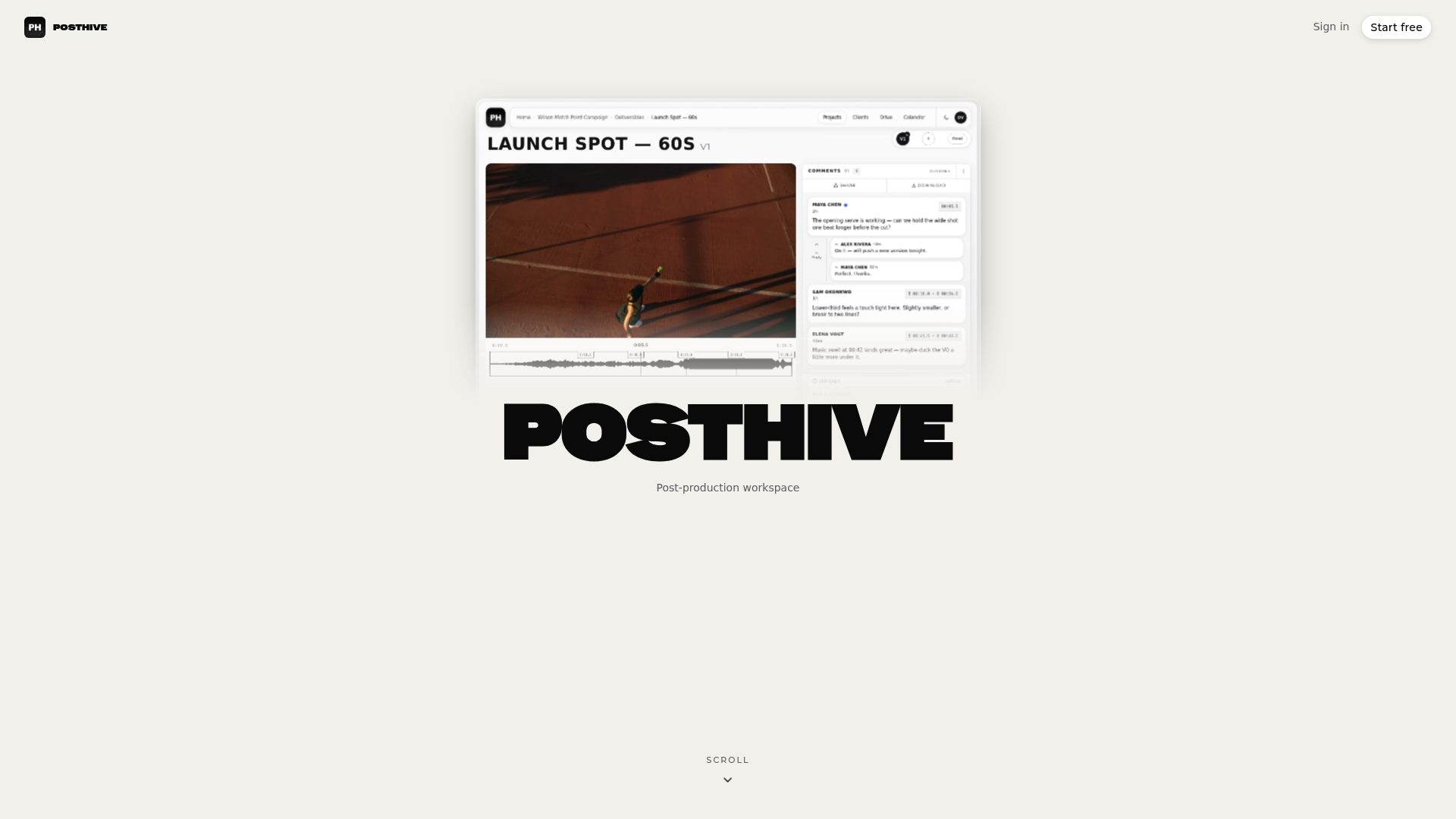
- Version management keeps every cut, grade pass, and mix tied to the review round it came from, so nobody works from an outdated file.
- Task and deadline tracking turns the phase blocks from your schedule into assignments with real dates attached.
- Calendar integration syncs those dates with Google Calendar, so picture lock and delivery deadlines show up where your team already looks.
- Client ownership of deliverables means your client reviews and approves versions directly, cutting the back-and-forth that eats into your review-round buffer.
If you’re ready to put your next schedule somewhere it will actually hold, check our Pro and Enterprise plans and see which fits your team’s deliverable volume.
FAQ
How many hours does editing take per finished minute?
Straightforward scripted editing commonly runs about 1 hour per finished minute, though complex projects can run several times higher. A second method multiplies total footage hours by 3 to estimate editing hours for scripted content, so 20 hours of footage points to roughly 60 editing hours.
What is a pipeline proficiency test and why does it matter?
A pipeline proficiency test runs representative footage through your actual ingest, transcode, and editing systems before the real project starts. The Editors Guild recommends it to catch codec, transfer, and metadata problems while they’re still cheap to fix.
How many review rounds should I budget for a project?
Most projects need 1 to 3 review rounds, with each round costing prep time, the review meeting itself, and the time to implement changes. Cosmetic notes move through a round quickly, while restructure notes can extend a single round by a day or more.
When should VFX work start relative to picture lock?
On tight turnarounds, VFX work often needs to start before the full picture lock, especially for complex shots that take longer to produce. Guidance from the Editors Guild recommends bucketing shots by complexity and starting the hardest ones as early as locked sections allow.
How does Posthive help teams track post-production deadlines?
Posthive combines version management, task and deadline tracking, and calendar integration in one workspace, so every phase of a schedule has an owner and a date. Pricing starts at $49 per month on the Pro plan, with an Enterprise plan available for larger teams.