One Week to Validate Your Approval Tracking Workflow for Creative Managers
One Week to Validate Your Approval Tracking Workflow for Creative Managers

An approval tracking workflow gives every request a single authoritative status, an explicit approver path, and measurable turnaround targets, so teams stop chasing sign-offs over email and chat. This guide walks through how to design one, automate it, govern it with version control and audit trails, and measure whether it is actually working.
TL;DR:
- Matching routing patterns to actual decision-making processes prevents delays caused by inappropriate sequential or parallel approval flows.
- Properly mapping approval stages, ownership, escalation rules, and rework loops on paper avoids failures during real projects.
- Automating approvals via platforms like Power Automate or Salesforce depends on trigger events and requires reliable version control and audit trails.
- Version-specific feedback and immutable snapshots prevent errors and disputes, especially when managing multiple revisions.
- Monitoring key metrics such as response times, rework cycles, and overdue approvals helps identify process inefficiencies needing targeted improvements.
Table of Contents
- What is an approval tracking workflow, and which type fits your team?
- Why approval workflows break down: common failure modes
- How to design and map an approval tracking workflow
- Automation options and integrations: practical choices
- Version control, audit trails, and governance for approvals
- Metrics, reporting, and monitoring approval status
- Implementation checklist and templates to test in a sprint
- How we approach approval tracking for creative teams
- Should you fix your process first or adopt new software?
- A workspace built around approval tracking: Posthive
- FAQ
- Sources
What is an approval tracking workflow, and which type fits your team?
An approval tracking workflow is a defined sequence of review and sign-off steps for a piece of work, with a visible status at every stage, a named approver for each step, and a record of who decided what and when. It replaces the informal version where a file gets emailed around and someone eventually says “looks good” in a reply three threads deep.
Three routing patterns cover most real-world cases:
- Sequential routing: one approver signs off before the request moves to the next, useful when a creative director must clear a cut before a client ever sees it.
- Parallel routing: multiple approvers review at the same time, useful when legal, brand, and a producer all need to weigh in on a deliverable with no dependency between them.
- Conditional routing: the path changes based on metadata, such as sending anything over a certain budget to a senior approver while routine edits skip that step.
Choosing wrong causes most of the pain teams report later. Sequential routing on work that needs parallel input just adds delay; parallel routing on work that needs a strict order causes people to approve versions that get superseded mid-review. Match the routing pattern to how the decision actually gets made today, not to how an org chart suggests it should be made.
Why approval workflows break down: common failure modes
Most broken approval processes share a small set of root causes, and diagnosing them before you automate anything saves rework later.
- Scattered feedback and version drift: comments land in email, chat, and file comments simultaneously, and nobody reviews the same version twice.
- Unclear ownership: a request sits because no single person is named as the approver, so everyone assumes someone else is handling it.
- Missing escalation rules: when an approver goes on vacation or simply forgets, there is no automatic path to a backup.
- Notification fatigue: so many status emails go out that approvers start ignoring all of them, including the ones that matter.
- No audit trail: when a client disputes a delivered version, nobody can show who approved what, or when.
Pro Tip: Before building any automation, map your last ten real approval cycles on paper and mark exactly where each one stalled. That list becomes your requirements document.
How to design and map an approval tracking workflow
Building a workflow that survives contact with real projects starts with a clear map, not a tool.
- Define intake metadata: capture what is being approved, who requested it, the deadline, and the acceptance criteria before routing begins.
- Map the stages: list every review step in order, name the approver (not just the role), and mark which stages run sequentially versus in parallel.
- Set branching rules: decide what conditions change the path, such as budget thresholds, client tier, or asset type.
- Set service-level targets: assign a maximum response time per stage, such as 24 hours for internal review and 48 hours for client sign-off.
- Build escalation and delegation rules: name a backup approver and the trigger that hands a request to them automatically.
- Plan for rework loops: decide what happens when a reviewer rejects a version, including whether it restarts the whole chain or only the current stage.
Keep a short list of edge cases visible while you map:
- What happens when an approver is unreachable for more than the SLA window.
- What happens when a request is canceled mid-review.
- What happens when two reviewers disagree on the same stage.
A workflow that only handles the happy path will fail the first time a real project hits a snag, which is usually within the first week of use.
Automation options and integrations: practical choices
Once the workflow is mapped, automation turns it from a diagram into something that actually enforces itself. Most platforms trigger on one of three events: a form submission, a file upload to a watched folder, or an API or webhook call from another system.
Power Automate offers a built-in “Approvals, start and wait for an approval” action that creates the request, notifies the named approver, and waits for a decision before the flow continues. A typical pattern looks like: trigger on file upload, start the approval action, branch on the decision outcome, then update a record or send a notification. For approvals that can run longer than 30 days, Power Automate recommends storing them in Microsoft Dataverse so the flow can track state reliably over an extended period, which matters for client sign-offs that stretch across holidays or long review cycles.
Salesforce’s approval steps work differently: steps can route to a user, a group, or a queue, with conditions controlling when each step starts, and approvers can respond directly from email. Decision variables like approval status and comments then feed downstream automation, so a rejection can automatically reopen a task without manual intervention.
- Email approval is faster to set up but risks accidental approvals if reply keywords are not configured carefully.
- In-app approval is slower to adopt but keeps the full context, attachments, and comment history in one place.
- For media teams specifically, the integration points that matter most are NLE plugins for sending cuts directly to review, cloud storage for the actual files, and calendar sync so deadlines show up where people already look.
Approval automation reduces the manual coordination effort that otherwise falls on a producer chasing sign-offs one person at a time, according to Power Automate’s approval workflow documentation, which frames the value of automated routing as replacing ad hoc requests with a structured, trackable process.
Version control, audit trails, and governance for approvals
Nothing undermines an approval faster than discovering the reviewer signed off on the wrong file. Post-production and content teams need versioning that locks the exact asset at the moment of decision, not a live link that keeps changing.
- Use snapshot-based versioning, where the exact file reviewed is captured and stored alongside the approval record, rather than a pointer to a file that can still be edited.
- Record the full audit trail: who reviewed, what version they saw, the timestamp, and a copy or link to the attachment as it existed at that moment.
- Set retention rules for how long approval records and snapshots stay available, especially for client handoffs where a dispute might surface months later.
- Apply consistent naming and tagging so a version number in a filename always matches the version number in the approval record.
Pro Tip: Never let “final” mean the same thing as “final_v2.” Tie every approval decision to an immutable snapshot, not a filename convention that people will eventually break.
Our guide on version control for creative teams covers snapshot practices in more detail for teams handling frequent revisions.
Metrics, reporting, and monitoring approval status
A workflow you cannot measure is a workflow you cannot improve. Four metrics cover most of what managers need to know about approval health.
- Time to first response: how long before an approver even opens the request.
- Time to final decision: the full cycle from submission to a recorded yes or no.
- Rework cycles: how many times a single item gets rejected and resubmitted.
- Overdue approvals: how many requests are currently past their SLA.
Dashboards should surface overdue items first, since those are the ones actively costing time right now, and alerts should go to the backup approver automatically once an SLA is breached, not just to the original approver again.
| Maturity level | Time to final decision | Rework cycles per item | Overdue approvals |
|---|---|---|---|
| Starting out | Unpredictable, often multiple days | Frequent, often 3 or more | Common |
| Developing | Within defined SLA most of the time | Occasional, 1 to 2 | Rare |
| Mature | Consistently within SLA | Rare | Near zero |
Use these targets as a direction rather than a fixed benchmark, since acceptable turnaround varies by industry and client expectations. The point of tracking them is to find where your process is actually losing time, then fix that specific stage before touching anything else.
Implementation checklist and templates to test in a sprint
A one-week pilot is enough to validate most of the design decisions above before committing to a full rollout.
- Identify the stakeholders and confirm each approver by name, not by role.
- Build the intake form with the metadata fields the workflow depends on.
- Configure routing for one real project type, starting with the simplest path.
- Set SLAs and one escalation rule.
- Run three to five real requests through the pilot and log every stall point.
Keep these template items ready before the pilot starts:
- A one-page intake form listing required fields and acceptance criteria.
- A routing map showing each stage, approver, and SLA.
- A test case list covering a standard approval, a rejection and resubmission, and a missed-deadline escalation.
Our handoff checklist for agency delivery offers a template for the acceptance-criteria piece specifically, which is often the weakest part of a first draft.
How we approach approval tracking for creative teams
We built our version management around one principle: clients and teams should never be reviewing or approving the wrong file. Every deliverable keeps its version history intact, and feedback attaches directly to the specific version it was given on, so a rejection on version 3 never gets confused with an approval on version 4.
- Review and task tracking live in the same workspace, so a rejected approval automatically surfaces as an open task instead of disappearing into a separate thread.
- Client ownership of deliverables means approvals and comments stay tied to the actual asset the client is paying for, not a temporary link.
- Calendar sync keeps approval deadlines visible alongside production schedules rather than buried in a separate tool.
Teams piloting this kind of workflow typically start with one project type, run it for a sprint, and expand once the routing and SLAs hold up under real deadlines. Our editor task tracking guide documents the task-tracking patterns that support this kind of handoff in more detail.
Should you fix your process first or adopt new software?

Fix the process before buying a platform when the main problem is unclear ownership or missing SLAs. Those are organizational fixes, not technical ones, and a tool will not solve them on its own.
Invest in automation once the process is mapped and the failure is volume or visibility: too many requests to track manually, or no reliable way to see what is overdue. The practical sequence is almost always test the process on paper first, then automate the version that already works, because automating a broken process just makes it break faster.
— Lorenz
A workspace built around approval tracking: Posthive
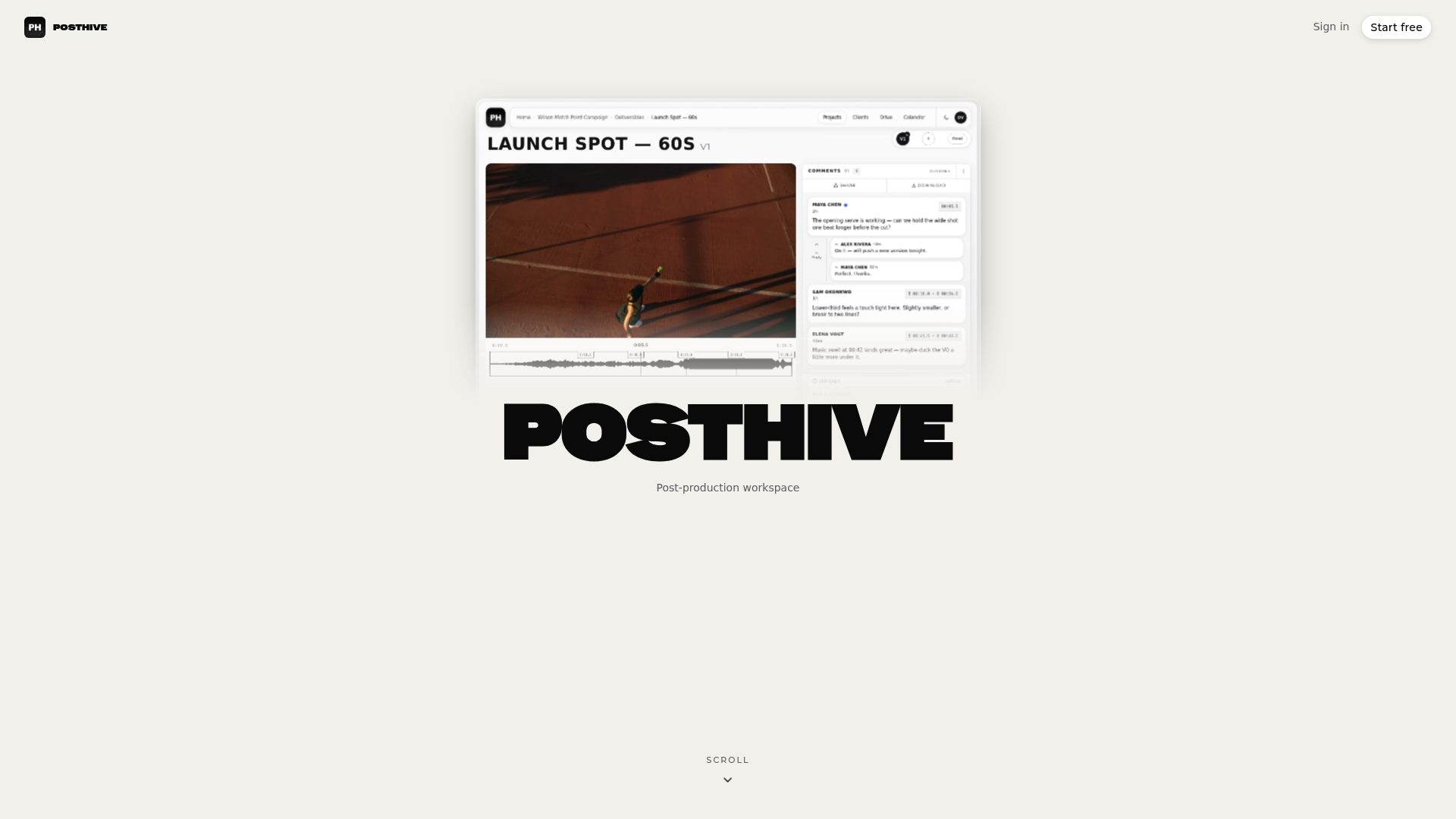
We built Posthive specifically for the version control and client-ownership problems that break most approval workflows: every deliverable keeps its own version history, client feedback attaches to the exact version it was given on, and review status stays visible alongside task tracking rather than scattered across email.
- Free seats on every plan, allowing clients and reviewers to join without additional per-seat costs.
- Calendar integration keeps approval deadlines visible alongside production schedules.
- Plugins support sending edits to review without manual file handling.
Teams typically pilot approval tracking in Posthive on one active project before rolling it out further. Compare the Pro and Enterprise plans to find the storage and feature tier that fits your team’s volume.
FAQ
What is an approval tracking workflow?
An approval tracking workflow is a defined sequence of review steps with a named approver at each stage, a visible status, and a record of every decision. It replaces informal email or chat approvals with a structured, auditable process.
How do I automate an approval workflow without building it from scratch?
Platforms like Power Automate include a built-in approvals action that notifies approvers and waits for a decision before continuing a flow, while Salesforce’s approval steps route requests to users, groups, or queues based on conditions. Both let you avoid custom-building the routing logic yourself.
What causes most approval workflows to fail?
The most common causes are unclear ownership of who approves what, missing escalation rules when an approver is unavailable, and no audit trail linking a decision to the exact version reviewed. Fixing these usually matters more than adding automation on top of a broken process.
What metrics should I track for approval status monitoring?
Track time to first response, time to final decision, number of rework cycles, and count of overdue approvals. These four numbers reveal where a workflow is losing time faster than any single pass or fail rate would.
Does Posthive support approval tracking for creative teams?
Posthive ties client feedback and approvals to specific asset versions within the same workspace used for task tracking, so a review decision never gets separated from the file it applies to. Pricing and feature details are available on the Posthive pricing page.
Sources
- Create and test an approval workflow with Power Automate - Power Automate | Microsoft Learn
- Approval Steps | Salesforce Help